
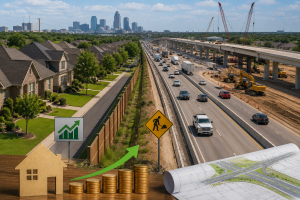
There’s an old real estate maxim that’s stood up pretty well over time: transportation infrastructure is the skeleton that everything else grows around. Roads don’t just move people from point A to point B — they determine which pieces of land become valuable, which corridors attract development, and which rural parcels quietly sit at the edge of the next growth wave.
In Texas, this plays out at a scale that’s hard to match anywhere else in the country. TxDOT manages one of the largest state highway systems in the world, and the pace of road expansion, widening, and new construction in Texas reflects a state that is genuinely trying to keep up with explosive population growth. For property owners, land investors, and buyers paying attention, highway projects aren’t just traffic news — they’re a leading indicator of where value is heading.
Here’s how it works, why it matters, and what smart buyers are actually watching.
The Mechanics: Why Roads Create Property Value
The connection between transportation and land value isn’t complicated at its core. Accessibility drives demand. When a piece of land becomes easier to reach — when commute times drop, when truck routes become more direct, when a formerly remote area gets connected to a major highway — its potential uses expand. And expanded use potential translates directly into higher value.
Before a new highway or interchange is built, land near the planned route often trades at rural or agricultural values. After construction, the same parcels may have direct access to high-traffic corridors and become viable for commercial development, residential subdivision, or industrial use. That transition in use potential is what drives appreciation, and it rarely happens all at once.
The appreciation typically comes in phases. The first phase happens when the project is announced or enters the environmental review process — informed buyers and land investors start accumulating positions in the path of the project. The second phase comes as construction begins and certainty increases. The third — often the most dramatic for surrounding properties — happens as development follows the completed infrastructure and the land use transition accelerates.
Buyers who get in during phase one capture the best upside. Those who wait until phase three are paying for appreciation that’s already happened.
Texas Highway Expansion: The Scale of What’s Happening
Texas has invested heavily in its transportation network for decades, and the pace hasn’t slowed. SH 130, Loop 49 in Tyler, the expansion of SH 183 in the DFW Metroplex, ongoing widening along US-290, and dozens of smaller projects across rural and suburban Texas are all working through the pipeline at any given time. The Unified Transportation Program — TxDOT’s ten-year planning document — is publicly available and details billions in committed and planned highway spending by district and project.
For land buyers and investors, that document is genuinely useful. It identifies which corridors are receiving funding, where interchange improvements are planned, and which rural highways are slated for capacity expansion. Cross-referencing UTP project data with current land prices in those corridors is exactly the kind of research that separates informed land investment from guesswork.
East Texas, in particular, has seen meaningful highway investment in recent years. Loop 49 around Tyler has transformed land value patterns in Smith County. The ongoing expansion of US-59 and its eventual upgrade to Interstate 69 status has been reshaping East Texas land markets for years, with commercial and residential development following the improved corridor southward from the DFW area through Lufkin and beyond.
For buyers interested in East Texas land near growing transportation corridors, a property like the 30± acre parcel in Lufkin, TX illustrates the kind of acreage positioned near active infrastructure corridors — a useful reference point for understanding how land near improved highways is currently priced and positioned in this part of the state.
Commercial Real Estate: The Direct Beneficiary
If there’s a single property type that benefits most directly and most predictably from highway expansion, it’s commercial real estate near new or improved interchanges. The logic is straightforward: retail, fuel stations, restaurants, hotels, logistics facilities, and light industrial users all need highway access, and they compete for the limited commercial land near interchanges once a project is complete.
The appreciation on commercial corridor land near newly completed Texas highway projects has been well documented across multiple regions. Land along SH 130 near Austin that traded at agricultural prices before construction was completed has seen dramatic value increases as the corridor developed. Similar patterns have played out along the Grand Parkway segments around Houston, where each newly completed segment has triggered a wave of commercial and residential development in previously rural areas.
For investors specifically evaluating commercial land in Texas growth corridors, commercial property opportunities in Texas that sit near planned or recently completed highway projects represent one of the more time-tested entry strategies in the state’s real estate market.
Agricultural Land in the Path of Progress
Rural and agricultural landowners near planned highway corridors occupy an interesting position. The land they hold today may be valued for its agricultural productivity — what it produces in hay, cattle, row crops, or timber. But its longer-term value may be driven primarily by its proximity to infrastructure and the development potential that infrastructure unlocks.
This dynamic creates a dual-value proposition. The land earns its keep agriculturally while you hold it, and its appreciation trajectory is tied to the infrastructure investment happening around it. Farmers and ranchers who owned land near what became the SH 130 corridor or the Grand Parkway segments made exceptional returns not because they were real estate investors but because they happened to hold land in the right place when TxDOT built through the region.
You don’t have to get lucky that way. Paying attention to where highway investment is going — and buying agricultural land with good highway access in those corridors before the projects are complete — is a replicable strategy with a long track record in Texas. Agricultural land in Texas growth corridors is where this dual-value opportunity most frequently appears, and it’s worth evaluating with both current productivity and future infrastructure trajectory in mind.
Residential Property Near New Highways: A More Nuanced Picture
The relationship between highway proximity and residential property value is more complex than it is for commercial or agricultural land. Being near a highway is not the same as being on one, and that distinction matters a lot for residential buyers.
Properties within a reasonable drive of a major highway — say, five to fifteen minutes — tend to benefit meaningfully from highway access. Reduced commute times, easier access to employment centers, and improved connectivity all support residential demand and values. New suburban communities built near highway interchanges consistently trade at premiums over comparable communities further from major corridors.
However, properties directly adjacent to high-volume highways or interchanges — within a quarter mile — often face noise, light, and air quality issues that offset the access benefits. The sweet spot for residential appreciation is close enough to benefit from connectivity but far enough to avoid the downsides of direct highway adjacency.
Master-planned communities in Texas have understood this for decades. The best-selling residential developments near new Texas highway corridors are typically positioned two to five miles from major interchanges, connected by local roads that provide access without direct exposure. Buyers evaluating residential property in Texas growth areas near planned highway improvements should apply this same logic — proximity is valuable, adjacency often isn’t.
Reading the Signals: How to Track Highway-Driven Opportunity
The information needed to identify highway-driven land opportunities in Texas is largely public. The challenge is knowing where to look and how to interpret what you find. A few practical sources:
- TxDOT’s Unified Transportation Program (UTP) lists committed and planned projects by district and corridor with funding levels and projected timelines. It’s updated annually and publicly available on TxDOT’s website.
- Environmental Impact Statements and Environmental Assessments for major highway projects identify the specific corridor routes under consideration well before construction begins.
- Regional Metropolitan Planning Organizations (MPOs) publish long-range transportation plans for their areas that identify priority projects over a 20-25 year horizon. These plans signal where infrastructure investment is headed before it reaches the committed funding stage.
- County appraisal district records show recent comparable sales along corridors where highway activity is planned or underway — watching those comps move over time tells you where appreciation has already started.
The buyers who consistently find value ahead of the market in Texas land are almost always the ones doing this kind of homework. It’s not secret information — it’s just information that most buyers don’t take the time to track systematically.
Off-Market Land Near Infrastructure Corridors
One more dynamic worth understanding: the most attractivly priced land near Texas highway corridors rarely sits on the public market long, if it appears there at all. Family-owned agricultural land in the path of infrastructure investment often changes hands quietly, through broker relationships and direct conversations, before it ever appears on a listing platform.
By the time a parcel near a planned interchange shows up publicly listed, the sellers — or the brokers representing them — generally know what’s coming and have priced accordingly. The opportunity window at pre-infrastructure prices is typically narrow and moves through private channels. Off-market land listings in Texas are where buyers with strong broker relationships gain access to corridor land before it’s widely known to be in the path of growth.
For buyers who want to position strategically in Texas growth corridors — whether in commercial land, agricultural acreage, raw development sites, or residential positions — the starting point is understanding which corridors are receiving investment and finding a broker with genuine regional knowledge and off-market access in those areas.
Airstream Realty works across Texas land and property types with the regional depth to identify infrastructure-driven opportunity before it’s fully priced into the market. Whether you’re evaluating a specific corridor or still figuring out where to look, a conversation about what’s moving in Texas transportation and land is a productive place to start.
Browse the full range of available Texas land listings to get a current feel for what’s trading in different regions and where corridor-adjacent properties are positioned relative to agricultural and transitional land values.
The Bottom Line
Highway expansion in Texas isn’t just a transportation story. It’s a land value story. The corridors being built today are shaping which properties appreciate over the next ten to twenty years, and the buyers who understand that relationship — and act on it before the construction crews show up — are the ones who look smart in hindsight.
The information is there. The opportunity is real. The question is whether you’re paying attention to the right signals at the right time.
Frequently Asked Questions
Does highway expansion always increase nearby property values in Texas?
Generally yes, but with meaningful nuance. Commercial and agricultural land near new highway corridors and interchanges typically benefits significantly from improved access and development potential. Residential property close to but not directly on a highway also tends to appreciate due to reduced commute times and improved connectivity. However, properties directly adjacent to high-volume highway lanes or major interchanges can face noise, light, and air quality issues that offset the access benefits. Proximity helps; direct adjacency is more complicated.
How can I find out about planned highway projects in Texas?
TxDOT’s Unified Transportation Program (UTP) is the primary public source — it’s updated annually and lists committed and planned projects by district with funding levels and timelines. Environmental Impact Statements and Environmental Assessments for major projects are filed publicly and identify specific corridor routes under consideration. Regional Metropolitan Planning Organizations also publish 20-25 year long-range transportation plans that indicate where investment is heading well before projects reach the funded stage. All of these are accessible on TxDOT and MPO websites.
What types of Texas property benefit most from highway construction?
Commercial land near new or improved interchanges typically sees the most direct and dramatic appreciation — retailers, logistics users, hotel operators, and fuel stations compete for limited commercial-zoned land near high-traffic access points. Agricultural and transitional land in the path of highway corridors benefits from a shift in highest and best use as the infrastructure reduces its isolation. Residential properties in the two-to-five-mile range from major interchanges also tend to benefit from improved connectivity without the direct adjacency drawbacks.
Is Interstate 69 affecting land values in East Texas?
Yes, meaningfully. The ongoing upgrade of US-59 to Interstate 69 status has been influencing land markets along the East Texas corridor for several years. Improved interstate connectivity increases the commercial and industrial appeal of communities along the route, reduces effective travel times to major Texas metros, and signals a long-term commitment of infrastructure investment that developers and land investors factor into their positioning. Communities like Lufkin, Nacogdoches, and Livingston have seen commercial development interest increase in part due to this corridor’s trajectory.
What is the best strategy for investing in land near Texas highway corridors?
The most effective approach is identifying corridors in the planning or early-construction phase — before land prices fully reflect the coming infrastructure — and positioning in parcels with direct or near-direct access to the planned corridor. Agricultural land with good highway frontage in the path of expansion offers a dual-value proposition: current agricultural income while appreciation accretes. Working with brokers who have regional knowledge and off-market access gives buyers a window into properties that move before publicly listed inventory becomes available.
How does the Grand Parkway around Houston affect surrounding land values?
The Grand Parkway (SH 99) segments around Houston have been one of the most studied examples of highway-driven land value transformation in Texas. Each newly completed segment opened previously rural areas to suburban development, triggering waves of residential master-planned communities and commercial development along the corridor. Land that traded at agricultural values before segment completion has in many cases appreciated dramatically as the surrounding area transitioned to suburban use. The pattern has repeated across multiple segments over more than a decade of phased construction.
Are there risks to buying land near a planned highway in Texas?
Yes, and they’re worth understanding. Project timelines often extend significantly beyond initial estimates — land held in anticipation of a highway that takes fifteen years to complete carries a long holding period. Project routes occasionally shift during environmental review, potentially changing which specific parcels benefit most. Eminent domain is also a factor: TxDOT can acquire portions of private land needed for right-of-way, and while compensation is required, the process can be disruptive and the compensation sometimes contested. Buyers should evaluate corridor land with realistic assumptions about timeline and factor holding costs into their investment calculus.