
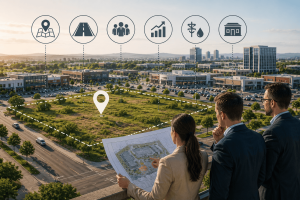
Most landowners think about their property from the inside out — what it means to them, what they’ve done with it, what it’s worth based on what they paid. Commercial developers think about land completely differently. They’re running a different calculation entirely, and understanding that calculation is genuinely useful whether you’re a landowner wondering what your acreage might be worth to a developer, an investor trying to identify land with commercial upside, or a buyer trying to understand what makes certain properties trade at significant premiums.
The short version is this: developers aren’t buying land, they’re buying feasibility. They want sites where the math works — where the combination of location, infrastructure, entitlements, physical characteristics, and market demand lines up well enough to justify the capital, time, and risk that commercial development requires. Every factor on that list is a potential deal-maker or deal-breaker.
Here’s what actually goes into that calculation.
Location and Traffic: The Foundation of Commercial Site Selection
Location in commercial real estate isn’t just about being in a good city or a growing county — it’s about specific position within a market. Two parcels five miles apart can have dramatically different commercial development potential based on where exactly they sit relative to traffic, rooftops, and competing uses.
Traffic counts are one of the first things a commercial developer looks at. Average daily traffic on an adjacent highway or arterial road is a direct proxy for customer visibility and accessibility, which is the foundation of most retail and hospitality uses. A parcel on a corridor carrying 30,000 vehicles per day attracts a completely different developer profile than an identical parcel on a road carrying 5,000.
Equally important is the surrounding population density and demographics. Developers doing commercial site selection in Texas run detailed analyses of household incomes, age distributions, and spending patterns within one, three, and five-mile radii of a potential site. A site with the right traffic count but the wrong surrounding demographics for a particular use still doesn’t work. Both have to align.
Visibility matters too — something that doesn’t always show up in data but gets assessed on every site visit. Can the site be seen from the road? Is there signage potential? Does the topography create a natural visual advantage or a disadvantage? These questions shape what a developer can build and how it will perform once open.
Access and Frontage: More Technical Than It Sounds
Direct highway or major arterial frontage is one of the most consistently valued features in commercial land. Developers — especially those building retail, fast food, convenience, or hospitality uses — want customers to be able to get in and out easily, and they want the site to read clearly from the road at highway speed.
But frontage alone isn’t enough. The specific access points available on a site matter enormously. Can the site get a full-movement access (left turn in, left turn out) from the adjacent road? Is a traffic signal possible or already present? Are there median cuts that allow U-turn access for traffic traveling in both directions? These details, which might sound minor to a landowner, significantly affect a site’s appeal to commercial users and directly impact what can be built and how it will perform.
Developers also evaluate the overall circulation pattern around a site — how traffic flows from the highway to the site, through the site, and back out. Awkward access configurations create real operational problems and can push certain users away entirely. A site with excellent location but poor access geometry will trade at a discount compared to a comparable site with clean in-and-out access.
The 394± acre parcel at the northwest corner of Hwy 20 and 155 in Tyler, TX is an example of a large-scale site where highway intersection positioning — one of the strongest commercial access configurations available — is a primary component of the property’s developer appeal.
Utilities: The Infrastructure That Makes or Breaks a Deal
Commercial development without utilities isn’t really commercial development — it’s an expensive engineering problem. Water, sewer, electricity, and natural gas availability near or at a site can be the single factor that separates a developable site from land that sits for years waiting on infrastructure.
Water and sewer are typically the highest-stakes utility questions for commercial sites. Municipal water and sewer service means a developer can size their project for the market without worrying about well capacity or septic system limitations. Land outside utility service areas — or with only partial utility access — either requires significant infrastructure investment or caps what can be built there. Both scenarios reduce what a developer is willing to pay.
Electrical capacity matters for industrial and warehouse users in particular. A site near a major substation with available capacity is substantially more attractive to industrial developers than a site requiring miles of new transmission infrastructure. Fiber and telecommunications infrastructure is increasingly a factor as well, particularly for office, medical, and data-intensive commercial uses.
Smart landowners near growing Texas communities periodically check on utility extension plans in their area. Knowing that a water line is being extended along a corridor in the next two to three years — before the developer community has fully recognized it — can identify acquisition timing and negotiation context that others miss.
Zoning, Entitlements, and the Cost of Uncertainty
Entitlement risk is real money to a commercial developer. The process of getting a piece of land rezoned, permitted, and approved for a specific commercial use takes time, costs money, and carries the possibility of denial. Every dollar and month spent navigating that process is factored into what a developer will offer for a piece of land.
Land that already carries commercial or mixed-use zoning trades at a meaningful premium over agricultural or residential-zoned land with commercial potential. A parcel zoned for commercial use eliminates one of the most common development obstacles and shortens the path from site control to construction start.
Beyond base zoning, developers look at what the entitlement pathway looks like for a specific use. Is the governing municipality developer-friendly? How long does the rezoning or special use permit process typically take? Are there overlay districts, historic designations, or environmental restrictions that could complicate approval? A site in a fast-moving Texas city with a streamlined permitting process is more attractive than a comparable site somewhere with a contentious or slow approval history.
Physical Characteristics: Flat, Dry, and Buildable Wins
The physical condition of a site — topography, soil bearing capacity, drainage, flood exposure — directly affects the cost of site preparation and the feasibility of specific building types. A flat, well-drained site with good soil requires minimal grading and earthwork before vertical construction begins. A site with significant grade changes, poor drainage, or expansive soils adds cost and complexity that developers model carefully.
FEMA flood zone designation is a significant factor. Sites in Special Flood Hazard Areas (100-year floodplain) require flood insurance, face restrictions on certain building types, and often require costly elevation or drainage engineering to make commercially viable. Developers working with institutional financing typically avoid significant floodplain exposure altogether. Even partial floodplain coverage on a site can complicate development of the affected portion.
Soil conditions matter for heavier uses — industrial buildings, multi-story structures, large paved surfaces. Sites with known soil issues (expansive clay, low bearing capacity, fill areas) require geotechnical investigation and potentially significant foundation engineering. This adds both cost and schedule to a project, both of which reduce what a developer will pay for the land.
Market Timing and Surrounding Development Activity
Even a site that checks every physical and infrastructure box can sit undeveloped if the surrounding market isn’t ready for it. Commercial developers are highly sensitive to market timing — they need the population, income, and demand support to be present at the scale their project requires before committing capital.
This is why surrounding development activity is itself a signal of developer interest. When major retailers, grocery chains, or national restaurant brands have already committed to a corridor, it validates the market for the next wave of development. Their site selection teams run the same demographics and traffic analyses that developers run, and their presence is a credible endorsement of the market.
The inverse is also true. A corridor with obvious infrastructure and location advantages but zero existing commercial activity raises questions about what market research has shown that isn’t visible from the road. The absence of development isn’t always explained by zoning or access — sometimes it reflects demand data that the market knows but the casual observer doesn’t.
For buyers and investors evaluating commercial land in Texas, commercial property listings across Texas growth markets provide a current view of how developer-ready sites are being priced and positioned across different corridors and use types.
Size, Configuration, and Assemblage Potential
Commercial developers have specific size requirements for different project types, and a site that’s the wrong size — too small, oddly shaped, or without room for adequate parking — may simply not work regardless of its other attributes. National retailers typically specify minimum site sizes, building setback requirements, and parking ratios that are non-negotiable for their prototype buildings.
Large-format users — big box retail, power centers, distribution centers, regional shopping — require substantial acreage that often exceeds what a single parcel provides. This is where assemblage comes in: combining multiple adjacent parcels to create a site of sufficient size. Landowners holding adjacent parcels to a key commercial site may have more leverage in that situaion than they realize, particularly if a developer needs their land to complete an assemblage.
For investors and landowners thinking about commercial potential, land listings in Texas that sit adjacent to or near established commercial corridors are worth evaluating with assemblage potential in mind — not just standalone development feasibility.
Working With Brokers Who Understand Developer Criteria
Identifying whether a piece of land has genuine commercial development potential — and what that potential is worth — requires specific knowledge of how developers evaluate sites. It’s a different lens than residential or agricultural valuation, and it’s informed by deal experience across multiple property types and markets.
The landowner who understands what their property looks like through a developer’s eyes is in a much stronger negotiating position than one who doesn’t. And the buyer who can identify developer-ready characteristics before the rest of the market recognizes them is the one who captures the most meaningful appreciation.
Whether you’re evaluating agricultural land with commercial transition potential, looking at off-market land in Texas growth corridors, or considering residential properties in areas experiencing commercial expansion, the criteria developers use to evaluate sites provides a useful framework for identifying what’s likely to appreciate and what isn’t.
Airstream Realty works with buyers, sellers, and investors across Texas commercial, land, and development property — with the market depth to assess developer appeal across different corridor types and use categories. If you want a specific conversation about a property’s commercial potential or development trajectory, reaching out directly is the best starting point.
Frequently Asked Questions
What is the most important factor commercial developers look for in a site?
There’s no single universal answer because the most important factor shifts by use type — retail prioritizes traffic and demographics, industrial prioritizes access and utility capacity, office prioritizes visibility and fiber infrastructure. That said, location and access consistency appear at the top of virtually every developer’s checklist regardless of use. A site that’s in the right place and can be accessed cleanly is the baseline on which everything else is evaluated. Without those two things, the other factors rarely matter.
Does zoning have to be commercial before developers will look at a site?
Not necessarily, but commercial zoning significantly increases a site’s attractiveness and value. Developers will pursue rezoning when the site’s other characteristics are strong enough to justify the time, cost, and risk of the entitlement process. However, they price that risk into what they’re willing to offer. A site already zoned commercial trades at a premium over a comparable site requiring rezoning — the premium reflects the time and uncertainty that the landowner, rather than the developer, has already absorbed.
How do utility extensions affect commercial land value in Texas?
Significantly. Land outside municipal utility service areas typically trades at a meaningful discount to comparable land with full utility access. When utilities extend — particularly water and sewer — to a previously unserved area, the land that gains service often appreciates quickly as commercial feasibility improves. Tracking where utility extensions are planned in growing Texas communities is a legitimate strategy for identifying commercial land value uplift before it’s fully reflected in pricing.
What traffic count is typically needed for commercial retail development?
Requirements vary significantly by retail format. Convenience stores and fast food users typically look for arterial traffic counts in the 15,000 to 25,000 vehicles per day range as a minimum threshold. Larger format retail and grocery anchors generally want primary corridors carrying 30,000 or more vehicles per day. Regional retail centers and power centers need even higher surrounding traffic volumes and typically want to be positioned near major highway interchanges. These are general thresholds — specific retailers have their own proprietary site criteria that can vary from these ranges.
What is land assemblage and why does it matter for commercial development?
Land assemblage is the process of combining multiple adjacent parcels to create a single site large enough for a specific development use. Many commercial projects — particularly large-format retail, industrial parks, and mixed-use developments — require more acreage than any single parcel provides. When a developer is assembling land, the owners of adjacent parcels have leverage they may not be aware of, since the developer needs their cooperation to complete the site. Landowners adjacent to active assemblage activity are often in a stronger negotiating position than standard market comparables would suggest.
How does floodplain affect commercial development potential in Texas?
FEMA Special Flood Hazard Area (100-year floodplain) designation is a significant development obstacle for commercial uses. It requires flood insurance, restricts certain building types, and often necessitates costly elevation or drainage engineering. Institutional lenders typically limit or avoid financing commercial projects with significant floodplain exposure, which narrows the developer pool considerably. Even partial floodplain coverage reduces the usable area of a site and complicates site planning. Sites with clean floodplain status — entirely outside the 100-year boundary — trade at a premium in active Texas development markets.
What types of commercial developers are most active in Texas right now?
Industrial and logistics developers have been among the most active in Texas for the past several years, driven by e-commerce growth and supply chain demand. Multifamily residential developers — technically a form of commercial development — have been extremely active in DFW, Houston, San Antonio, and Austin. Medical office and healthcare facility developers are active in suburban growth corridors following population growth. Convenience retail and quick-service restaurant developers continue acquiring sites along Texas highway corridors at a steady pace. The common thread across all of these is that they’re following population growth — and Texas continues to be one of the primary destinations for that growth nationally.