
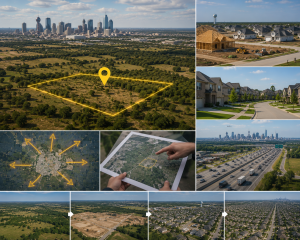
Some of the most valuable land in North Texas is still being taxed as farmland. The people who own it often don’t know what they’re sitting on — until someone else figures it out first.
Meanwhile, the highway they’ve driven past for twenty years just got widened. A school district boundary that used to end two miles away now includes their property. A homebuilder they’ve never heard of quietly bought the five hundred acres to the east. And a broker they’ve also never heard of is going to call them in the next six months with an offer that will reframe everything they thought they knew about what they own.
This is the DFW land development story told at the individual property level. Not the macro narrative about Texas growth — the specific story about a piece of ground and the moment when its relationship to growth changes. This post is about how to recognize that moment before someone else recognizes it for you.
What “Path of Growth” Actually Means
The phrase gets used loosely. Every Texas landowner within a hundred miles of Dallas has heard that their land might be “in the path of growth.” Some of it is. Most of it isn’t — at least not yet, and possibly not within any planning horizon that’s relevant to current decision-making.
Path of growth land has a specific meaning in development practice. It’s not just land that’s near a growing area. It’s land that a developer, homebuilder, or commercial operator will need in a defined timeframe because confirmed demand is moving toward it through confirmed infrastructure. The combination of both elements — demand and infrastructure — is what creates the development path. Either one alone doesn’t.
Land near a growing area but without infrastructure serving it is speculative land. It might appreciate. It might not. Land in a confirmed infrastructure corridor with demonstrated demand behind it isn’t speculative in the same way — it’s early, but it’s directionally clear. That’s what serious investors are looking for, and it’s what distinguishes a development path from a hope.
“The difference between land in the path of growth and land adjacent to growth is the difference between early and too late. Both can look the same on a map.”
The DFW Growth Corridors in 2026: Where the Development Path Is Moving
The DFW growth corridors have extended significantly over the past decade, and the picture in 2026 is meaningfully different from even five years ago. The inner ring suburbs have largely been absorbed — Plano, Frisco, Allen, McKinney, Flower Mound. These are mature markets. The development path has moved outward.
The Northern Corridor: Collin and Grayson Counties
North along US-75 and US-380, the growth corridor has pushed through Celina and is moving toward Gunter, Van Alstyne, and Sherman. Celina’s population has grown faster than almost any city in Texas in recent years, and the infrastructure investment following that growth — roads, schools, utilities — is now creating development pressure in the adjacent communities that were still agricultural just three years ago. The question in this corridor isn’t whether development will arrive — it’s when, and which specific parcels are in the immediate path versus adjacent to it.
The Western Corridor: Denton and Wise Counties
West along US-380 and FM 455 from Denton toward Ponder, Krum, and the communities approaching Decatur from the east, the western corridor is earlier in its development cycle than the northern one. Infrastructure is arriving but hasn’t fully arrived. Which means land pricing here still partially reflects agricultural value rather than fully priced-in development value — the window that earlier-stage investors are trying to capture. The widening of US-380 through this corridor is the signal that transforms its timeline from speculative to credible.
The Southern Corridor: Ellis and Johnson Counties
South of Dallas along I-35E and US-287, the communities of Waxahachie, Midlothian, Ennis, and Corsicana are absorbing growth spillover from the saturated Dallas and Cedar Hill suburban markets. Midlothian in particular has seen significant industrial and residential development activity. The southern corridor benefits from both the push factor of DFW pricing pressure and the pull factor of the Toyota Motor Manufacturing complex and associated supplier development that has anchored industrial demand in the region.
How to Tell If Your Land Is Actually in the Path
Knowing the broad corridors is one thing. Knowing whether your specific parcel is in the development path is a more granular question that requires looking at several specific signals simultaneously.
Signal One: What’s Happening to Your Immediate Neighbors
Deed records are public in Texas, and county appraisal district websites allow property lookups by address or owner. If the parcels immediately adjacent to yours have recently changed hands — particularly to entities that aren’t individuals and don’t appear to be agricultural operators — that’s a meaningful signal. Homebuilders and developers typically assemble land in stages, and they don’t announce what they’re doing until they’re ready to. By the time there’s a public announcement, the option contracts and acquisitions have usually been happening for a year or more. A significant change in adjacent ownership composition is one of the earliest signals available to nearby landowners.
Signal Two: Infrastructure Investment Trajectory
TxDOT publishes its statewide transportation improvement program — the list of planned road projects with funding, timelines, and locations. This is public information. If your land sits within two to three miles of a road project that is funded, permitted, and scheduled, you are in a confirmed infrastructure corridor. The same applies to water utility expansion plans from municipal utility districts and rural water supply corporations, which are often the precondition for residential development that road expansion alone can’t enable.
Signal Three: School District Activity
Texas school districts track enrollment and project future growth. When a school district announces a bond election for new facilities or a boundary annexation that incorporates previously unserved rural land, that’s a downstream signal of projected population growth that the district has already modeled. School announcements typically lag the actual development commitment by one to three years — which means by the time a new school is announced in your area, the residential development that requires it has already been contracted or optioned in many cases.
Signal Four: Your Property Tax Assessment Trajectory
If your county appraisal district’s assessed value has been increasing significantly year over year even though the physical land use hasn’t changed, that’s a market signal you’re sitting on appreciated land. County assessors in Texas growth corridors typically lag the actual market by one to three years — so a significant run-up in assessed value often means the actual market has been ahead of that for a while. Rapidly increasing assessments on agricultural land in North Texas can be both a burden (higher taxes if the ag exemption lapses) and a signal that the market has already identified the development path potential.
What Landowners in the Development Path Should Be Doing Right Now
If the signals above suggest that your land is in or approaching an active DFW land development corridor, there are a few specific things worth doing before any transaction conversations begin.
First, get a current market valuation from a broker with active experience in your specific market. Not the county assessed value — the actual market value based on comparable transactions, current buyer demand, and the development signal picture described above. This gives you a baseline for any conversation that follows.
Second, understand your agricultural exemption status and the rollback implications if you sell. The rollback can be a significant cost in a transaction, and knowing it before you’re in a deal puts you in a much stronger negotiating position than discovering it during due diligence.
Third, consider whether your best path is a listed sale or an off-market transaction. For North Texas development land in active corridors, off-market transactions can produce competitive pricing while giving you more control over timing, confidentiality, and deal structure. Off-market land opportunities in North Texas work for buyers specifically because sellers haven’t gone through the public listing process — which means the market price hasn’t been tested by competitive bidding. For sellers, the same dynamic can be leveraged to find a specific buyer who needs your land and will pay for it accordingly.
For landowners whose property is in an East Texas or non-DFW corridor but who believe they’re in a path of some development activity, the same principles apply at a different price level. A property like this 30-acre tract near Lufkin TX is an example of the kind of regional land holding that benefits from the same development-path analysis — what’s happening in adjacent areas, what infrastructure investment is occurring, and what that means for the current versus potential value of the land.
For landowners specifically evaluating commercial potential — land at highway intersections, near employment centers, or in commercial-need corridors — commercial land in Texas has its own specific buyer pool and valuation framework that differs from residential development land. Understanding which category your land falls into affects who the right buyer is and what the right marketing strategy looks like.
The full range of Texas land listings and market intelligence, along with agricultural land in Texas and residential land, are all part of the broader picture that informs how your specific parcel sits relative to the market. For a direct conversation about a specific property and its development potential, Airstream Realty works with landowners across North Texas and the broader state on exactly these situations.
Frequently Asked Questions
How do I find out if a road expansion is planned near my land?
The Texas Department of Transportation publishes the Statewide Transportation Improvement Program (STIP), which lists all funded and planned road projects with locations, timelines, and funding sources. This is publicly available on TxDOT’s website. County transportation departments also maintain records of county road improvement plans. For landowners who want to know whether a specific highway or road near their property is in the improvement queue, the TxDOT project viewer and the relevant district office are the primary sources. Real estate brokers active in the North Texas market typically have working familiarity with the road improvement picture in their specific corridors.
What is the difference between land in a DFW growth corridor versus land adjacent to growth?
Land in a growth corridor has both infrastructure investment directed toward it and confirmed demand behind that infrastructure. Land adjacent to growth has proximity to a growing area but lacks one or both of those elements — typically either the infrastructure doesn’t extend to it, or the demand behind the infrastructure hasn’t reached it yet. The distinction matters significantly for pricing: in-corridor land commands development-path premiums, while adjacent-to-growth land is priced more on speculation and agricultural value. The signals that identify in-corridor land — highway projects, utility extensions, builder acquisitions in adjacent parcels — are the difference between proximity and actual path positioning.
How long does it typically take for DFW growth to reach land in the outer corridors?
The timeline varies significantly by corridor, infrastructure confirmation status, and the specific distance from the established development edge. In the most active North Texas growth corridors — Celina and the US-380 extension, for instance — the timeline from early land acquisition to active residential development has compressed to three to seven years for well-positioned parcels in confirmed infrastructure paths. More distant or less-infrastructure-connected land may have longer timelines of seven to fifteen years. The presence of confirmed infrastructure investment is the most reliable signal for timeline compression — when roads and utilities are funded and scheduled, the development timeline typically follows within five years of infrastructure completion.
If my land is in a DFW growth corridor, should I sell now or hold for more appreciation?
The honest answer depends on where in the appreciation cycle your specific parcel sits. If infrastructure has been confirmed and demand is active but the land hasn’t fully priced in the development premium yet, holding may capture significant additional appreciation. If the land has already been surrounded by developed product and is priced at or near development value, the remaining appreciation potential may be modest compared to the opportunity cost of capital tied up in a low-yielding asset. Getting a current market valuation and understanding the cycle stage of your specific parcel is the starting point for this decision — and the answer is genuinely different for different parcels even within the same general corridor.
Can I look up recent land sales near my property to understand market conditions?
Yes. Texas deed records are public and searchable through county clerk websites or through third-party services like the Texas A&M Real Estate Research Center’s data tools, Zillow, and various county appraisal district websites. Searching for recent sales of comparable land parcels within a few miles of your property gives you a baseline for current pricing. Look at the sales price per acre, the date of sale, and whether the entity buying is an individual, a corporate entity, or a known homebuilder or developer. Changes in buyer type and price per acre over time are often more informative than any single transaction.
What types of buyers are typically interested in development-path land in North Texas?
The primary buyer types for development-path land in North Texas are regional and national homebuilders (who acquire land three to seven years ahead of planned development), commercial developers (who acquire land at highway intersections and in commercial-need corridors ahead of retail, industrial, or mixed-use development), land investment funds and REITs (who accumulate acreage in growth corridors for medium-term appreciation), and individual investors who are early-cycle buyers ahead of institutional interest. Understanding which buyer type is most relevant for your specific land — based on its size, location, frontage, and adjacent development activity — affects how the property should be positioned and marketed for maximum value.