
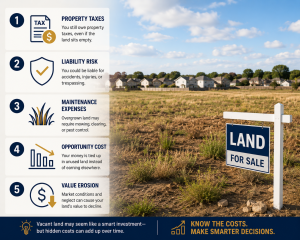
Buying land feels like the end of the financial transaction. It’s not. What comes after — the ongoing, often invisible costs of simply owning land you’re not actively using — is where a lot of landowners get surprised.
And that’s true enough as far as it goes. But “low-maintenance” is different from “no cost,” and the gap between those two things is where vacant land surprises landowners who haven’t thought through the full picture of owning land costs.
The costs of holding vacant land aren’t dramatic on a monthly basis. They’re steady. And over five to fifteen years — the typical holding period for development-path land — they add up in ways that affect the real return on your investment and the actual economics of the decision to hold versus sell.
Here are the five hidden costs that every Texas landowner should understand before they buy, and definitely before they decide how long to hold.
Cost One: Property Tax — and the Exemption Math
Property tax on land in Texas is the most visible holding cost, but it’s also the one most commonly misunderstood. The confusion comes from the agricultural exemption — the mechanism that allows qualifying land to be taxed at its agricultural productivity value rather than its market value.
When ag exemption is in place, the property tax bill on a 100-acre parcel can be a few hundred dollars annually rather than tens of thousands. That’s a meaningful reduction that changes the holding cost calculation significantly. Many landowners buy with the ag exemption in place and mentally assume the tax bill will remain manageable indefinitely.
The risk is transition. If the land is sold to a buyer who won’t maintain agricultural use — or if you make changes to the property that disqualify it from ag exemption — the rollback tax kicks in. Up to five years of deferred property taxes become immediately payable, plus interest. On a parcel with significant market value, the rollback liability can easily reach six figures.
The proactive approach: understand the current exemption status of any land you own or are considering, understand what maintains it, and factor the potential rollback exposure into any sale or use decision.
“The ag exemption is one of the best features of Texas land ownership — until it isn’t. Knowing what triggers the rollback is the difference between a planned cost and a surprise liability.”
Cost Two: Opportunity Cost of Tied-Up Capital
This one doesn’t show up on any bill, which is why it’s the most genuinely hidden vacant land expense on this list. Opportunity cost is the return you’re not earning because your capital is sitting in land rather than in another asset class.
If you have $500,000 tied up in a raw land parcel that’s generating zero income during the holding period, that capital is not in a dividend-paying stock portfolio, a rental property, a business, or a treasury bond. The forgone return on that capital is a real cost — it’s just not a cash outflow, which makes it easy to ignore.
The math depends on what you’d otherwise do with the capital. At a conservative 5% annual return on an alternative investment, $500,000 of land capital costs $25,000 per year in opportunity cost. Over a ten-year hold, that’s $250,000 in forgone return — more than most of the visible costs combined.
Opportunity cost doesn’t mean land is a bad investment. It means the land’s appreciation needs to justify not just the cash costs of holding it but also the return foregone by having capital in an asset that produces nothing during the hold. Development-path land in Texas growth corridors can absolutely clear this bar. But the calculation needs to be done explicitly, not assumed.
Cost Three: Liability Exposure and Insurance
Vacant land is not neutral ground from a liability perspective. Landowners can be held liable for injuries that occur on their property — and in Texas, the standard for liability to trespassers on rural land is more protective of landowners than in some states, but it’s not absolute. Recreational use provisions reduce (but don’t eliminate) liability for visitors who use the land for hunting, fishing, or recreation without charge.
The scenarios that create liability exposure on vacant land include: hunting accidents involving guests you’ve invited or allowed on the property, accidents involving children who wander onto the property (the “attractive nuisance” doctrine), injuries on the property related to hazardous conditions you knew about and didn’t address, and vehicle accidents on private roads that cross the property.
Land liability insurance is relatively inexpensive — typically a few hundred dollars per year for most rural parcels — but it’s a cost that should be factored into the annual carrying cost of the property. Many landowners skip it, accepting the exposure because the premium seems unnecessary. The scenario that makes the insurance worth every dollar it ever cost is the one that happens without warning.
Cost Four: Maintenance and Weed/Brush Control
“Vacant” land still needs attention to stay legally compliant and physically usable. In Texas, counties and municipalities can issue violations for failure to control noxious weeds and brush — particularly on land adjacent to roads, developments, or agricultural operations where invasive species can spread to neighboring properties.
Brush control on a 50-acre parcel might run $1,500 to $4,000 every few years depending on vegetation density, accessibility, and whether you’re doing it yourself or hiring a contractor. Noxious weed management on larger parcels can be a recurring annual expense. The cost of maintaining agricultural exemption often requires demonstrating active grazing or cultivation, which means either doing it yourself or paying someone to graze cattle or farm the land.
Fencing is another recurring maintenance cost that surprises landowners who weren’t thinking about it at acquisition. In Texas, fence maintenance is a shared responsibility between adjacent landowners for boundary fences — but if your neighbor isn’t contributing, you may be managing fence integrity alone to prevent livestock incidents or unauthorized access. Fence line maintenance on a perimeter of even a few thousand feet adds up over time.
Cost Five: Carrying Costs of Financed Land
This applies only to landowners who purchased with financing rather than cash — but it’s the most significant line item on the carrying cost ledger for those who did. Land loans in Texas typically carry interest rates above residential mortgage rates, reflecting the higher lender risk on an asset that produces no income and has a thinner secondary market than developed property.
At 7% interest on a $400,000 land loan, the annual interest expense is approximately $28,000 — before any principal repayment. Over five years, the interest cost alone approaches $140,000. A development-path parcel that appreciates 40% over five years would be worth approximately $560,000 at exit — but after the $140,000 in interest, the tax bill, the maintenance, and the other carrying costs, the actual net return is significantly less than the gross appreciation suggests.
This isn’t an argument against land financing — leveraged appreciation can still produce strong returns. It’s an argument for running the carrying cost math with actual numbers before making the decision, rather than looking at gross appreciation potential without accounting for what it costs to be in the position to capture it.
Property tax (without ag exemption on a $500k parcel): $8,000–$15,000/year.
Property tax (with ag exemption): $300–$800/year.
Rollback exposure if exemption lost: potentially $50,000–$100,000+ in a lump sum.
Liability insurance: $300–$600/year.
Brush/weed control: $500–$2,000/year averaged.
Fencing maintenance: $500–$2,000/year depending on perimeter and condition.
Interest on financed land (7% on $400k): approximately $28,000/year.
Opportunity cost (5% on $500k equity): approximately $25,000/year.
The visible cash costs are manageable. The opportunity cost and potential rollback are what require serious planning.
For landowners evaluating whether to hold or sell, understanding the cumulative carrying cost against the expected appreciation trajectory is the right analytical framework. And for buyers evaluating land across different property types — whether agricultural land, residential land, or commercial property — the carrying cost profile differs meaningfully by land type and needs to be part of the acquisition analysis.
For a current example of a well-positioned land asset, this 298-acre tract near Huffman, TX illustrates how acreage in the Houston MSA fringe balances near-term carrying costs against the development-path appreciation thesis. Off-market land opportunities are worth exploring for buyers who want entry points before market pricing reflects what sophisticated investors already know. The full Texas land inventory gives you the market context to evaluate the trade-off between acquisition price and projected carrying costs. And for any questions about a specific parcel’s carrying cost profile and hold strategy, Airstream Realty is the starting point.
Frequently Asked Questions
How much does it cost to hold vacant land per year in Texas?
The annual carrying cost of vacant land in Texas varies significantly based on whether an agricultural exemption is in place, whether the land is financed, and the cost of maintenance and insurance. With an agricultural exemption, cash carrying costs can be as low as $1,000 to $3,000 per year on a modest-sized rural parcel (taxes, insurance, basic maintenance). Without the exemption, property tax alone on higher-value land can reach $10,000 to $20,000 per year or more. Financed land adds interest expense on top of these costs. The opportunity cost of tied-up capital is the largest often-overlooked component and can equal or exceed the cash costs for larger land positions.
What is the agricultural exemption rollback tax in Texas and how does it affect landowners?
The agricultural exemption in Texas allows qualifying land to be taxed at its productive agricultural value rather than its market value, dramatically reducing annual property tax bills. When ag-exempt land is converted to non-agricultural use — including through sale to a buyer who won’t maintain agricultural use — up to five years of deferred property taxes become immediately payable, plus interest. This rollback tax can be substantial on high-value land, and responsibility for paying it is a negotiated contract term in land sales. Landowners holding ag-exempt land should understand the rollback exposure and factor it into any sale decision.
Do I need liability insurance for vacant land in Texas?
While not legally required, land liability insurance is strongly advisable. Landowners can face liability for injuries occurring on their property even when the land is vacant — from authorized or unauthorized users, from conditions on the property, and from third parties affected by conditions that originate on the land. Texas recreational use statutes reduce (but don’t eliminate) liability for landowners who allow public recreational use without charge. Land liability policies are relatively inexpensive (typically $300 to $600 per year for rural parcels) and provide meaningful protection against the scenarios — often unpredictable — that create liability exposure.
How long should I hold vacant land before selling?
The optimal holding period depends on the land’s position relative to development activity, the carrying costs being absorbed during the hold, and the investor’s overall capital situation. Development-path land that is confirmed in the growth corridor of a major Texas metro typically needs seven to fifteen years to fully realize its development-value appreciation. Mid-cycle acquisitions may produce returns in three to seven years. The carrying cost analysis — how much it costs annually to maintain the position — needs to be run against the projected appreciation timeline to determine whether the net return justifies the hold duration. There is no universal optimal holding period; the answer is specific to each parcel’s position in the development cycle and the landowner’s cost of capital.
Can I offset vacant land carrying costs with income?
Yes, in limited ways. Agricultural leases (for crops, cattle grazing, or hay production) generate modest income and, critically, maintain the agricultural exemption that keeps property taxes low. Hunting leases are another common income source on rural Texas land — rates vary widely by acreage, location, and hunting quality, but many rural landowners generate $5 to $20 per acre per year from hunting access fees. Cell tower and easement income can be significant on parcels with the right characteristics. None of these sources typically covers the full opportunity cost of the capital, but they reduce the annual cash outflow and help maintain the agricultural exemption that is often the most valuable carrying cost management tool available.
How do carrying costs affect the return on a land investment?
Carrying costs reduce the net return on land investment by the cumulative amount spent during the hold period. A parcel that appreciates 50% over ten years may produce a net return of 30 to 35% after factoring in ten years of property taxes, insurance, maintenance, and interest on any financing. For cash buyers in the ag-exempt category with low annual carrying costs, the reduction is modest. For financed buyers, the interest expense is the dominant carrying cost and can significantly reduce the net appreciation captured at exit. Running a full carrying cost projection alongside the appreciation estimate is the correct approach to evaluating a land investment’s expected return.