
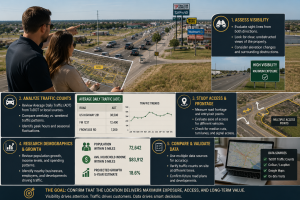
Location has always been the first rule of real estate. But in commercial land, location isn’t just about geography — it’s about how many people pass by, how fast they’re going, and whether they can actually see you.
That might seem narrow. But it reflects something fundamental about how commercial land strategy actually works, especially in retail and hospitality-driven uses. Traffic is exposure. Exposure is opportunity. And in commercial real estate, opportunity is the whole game.
This guide walks through how experienced commercial buyers think about visibility and traffic counts for commercial land in Texas — the metrics that matter, the questions worth asking, and the traps that catch buyers who don’t do their homework. Whether you’re evaluating your first commercial acquisition or the tenth, this is the framework that holds up.
Why Traffic Counts Are a Primary Filter for Commercial Buyers
Let’s start with the obvious question: why do traffic counts matter so much?
For most retail, restaurant, fuel, and hospitality uses, the customer base doesn’t come from a marketing campaign or a referral network. It comes from the road. People driving past, seeing a sign, making a split-second decision to pull in. That’s the reality of how a significant portion of commercial businesses acquire new customers — and if the road in front of your property doesn’t have the volume to generate that opportunity, the rest of the site evaluation doesn’t matter much.
This is why traffic analysis in real estate has become more sophisticated over the last decade. It’s not enough to know that a road is “busy.” Serious buyers want average daily traffic counts — the ADT figure — broken down by time of day, direction of travel, and ideally by vehicle type. A road that carries 30,000 vehicles per day means something very different to a gas station operator versus a furniture store versus a drive-through coffee concept. The same number can be excellent for one use and irrelevant for another.
“The number on the traffic count report is the starting point. The real evaluation begins when you start asking what those vehicles are actually doing and where they’re going.”
What Counts as “Good” Traffic for Different Commercial Uses
There’s no single answer to this — which is part of what makes retail land evaluation both an art and a science. But there are general benchmarks that experienced buyers use as starting points.
Convenience, Fuel, and Quick-Service Food
These uses are highly traffic-dependent and typically want to see minimum daily counts of 20,000 to 30,000 vehicles on the fronting roadway. Some national fuel and convenience operators won’t seriously evaluate a site below 25,000 ADT. The business model is built on volume — a lot of relatively small transactions — which means you need a lot of eyeballs passing by to make the numbers work.
Sit-Down Restaurant and Retail
These uses are somewhat less pure-traffic-dependent, because a good portion of their customer base comes from destination intent — people who looked them up and drove to them specifically. But high-traffic frontage still matters significantly for brand visibility and impulse capture. Counts in the 15,000 to 25,000 range are typically where these users start to get comfortable, with premium locations at major intersections often commanding significantly more.
Auto-Related and Big Box Uses
Auto dealerships, home improvement stores, and larger format retail users often care as much about access and visibility from the road as they do about raw count numbers. These are destination uses — customers are generally coming intentionally — but being visible and easily accessible from a major arterial still drives significant incremental traffic. Ingress and egress configuration often weighs as heavily as the count itself for these buyers.
Industrial and Warehouse
Here’s where the formula flips. Industrial users often actively prefer lower-traffic locations — they want truck access and proximity to logistics corridors, not retail visibility. For industrial land buyers, traffic count conversation is almost entirely about truck volume capacity on the road network, not passenger vehicle counts. A high-ADT arterial can actually be a disadvantage for industrial use if it creates congestion for freight movement.
Visibility: The Factor That Traffic Counts Can’t Fully Capture
Traffic count data tells you how many vehicles pass. It doesn’t tell you how many of them can actually see your property. That’s where visibility for commercial property becomes its own separate evaluation.
Speed Limits and Decision Points
A driver passing at 70 mph on a highway has a very different decision-making window than one traveling 35 mph on a commercial arterial. High-speed roads can carry enormous traffic volume and still be poor commercial frontage because there simply isn’t time for drivers to react, signal, decelerate, and turn in safely. The sight distance available to drivers approaching a property — the distance at which they can first see a sign or the entrance — is a specific measurable factor that commercial buyers take seriously.
Retail site selectors often talk about the “decision point” — the distance before the entrance where a driver has to commit to turning. If there are obstructions, curves, or competing signage that compress that window, the effective visibility of the site drops regardless of what the traffic count says.
Elevation and Grade
A parcel sitting below grade — lower than the road surface — is harder to see than one at grade or slightly elevated. Buyers evaluating pad sites pay close attention to how the ground sits relative to the road. A site that requires a retaining wall to bring it up to road level isn’t necessarily a deal-killer, but it’s a cost and a visibility issue that gets factored into the offer.
Competing Signage and Visual Clutter
Some commercial corridors are so heavily signed that any individual business struggles to be seen. A site with technically strong visibility can be effectively invisible in practice if it’s surrounded by large-format signs from neighboring users. Experienced buyers walk or drive the approach to a site specifically to evaluate what the driver’s eye actually lands on — and whether there’s any room in that visual field for a new tenant or owner.
Road Frontage: The Premium That Buyers Pay For
Road frontage value in Texas is directly tied to all of the factors above. Properties with long, unobstructed frontage on high-traffic arterials command price premiums that are sometimes substantial — and for good reason. That frontage is, in effect, free advertising for every business that operates on the site for as long as the property exists.
Buyers evaluating land with commercial intent will typically look at the frontage-to-depth ratio of a parcel. A site with 200 feet of frontage and 400 feet of depth is a very different commercial asset than one with 100 feet of frontage and 800 feet of depth, even if the square footage is similar. The former puts more of the property in the most valuable position relative to the road. The latter has less effective commercial frontage and more back land that doesn’t benefit from traffic exposure.
Corner sites — parcels at the intersection of two arterials — command the highest frontage premiums because they offer visibility and signage opportunities on two streets simultaneously. For fuel, convenience, and quick-service food users in particular, a well-positioned corner is often the top of the site selection wishlist.
Access and Ingress — The Often-Overlooked Third Factor
You can have strong traffic counts and excellent visibility and still have a site that underperforms — if getting in and out of the property is difficult or dangerous. Ingress and egress quality is the third leg of the commercial site evaluation stool, and experienced buyers give it serious weight.
Median cuts — the openings in a divided highway that allow left-turn access — can be make-or-break for commercial sites. A property without a median cut on a divided arterial is effectively invisible to half the traffic passing it. Buyers check existing median cut locations and, critically, whether TxDOT or local transportation authorities will permit new cuts or modifications. In some cases, a planned highway improvement can actually harm an existing commercial site by removing a median cut that served it.
Driveway stacking distance — the space between the property entrance and the nearest intersection — matters for high-volume uses like drive-throughs and fuel stations where car queuing can spill back into the road if the approach isn’t designed correctly. This is the kind of site-specific engineering detail that gets evaluated in earnest during due diligence, but smart buyers flag it early.
What This Looks Like in Practice: A Real Texas Example
All of this framework comes together when you’re looking at an actual property. Consider a large land holding at a major Texas highway intersection — the kind of site where multiple arterials converge and traffic counts are measurably strong on all approaches.
A property like this 350-acre commercial tract at the Hwy 410 and 37 interchange in San Antonio illustrates how visibility, traffic volume, and strategic position intersect in a single asset. Highway interchange locations in major Texas metros check nearly every box in the commercial site selector’s evaluation — high ADT on multiple approach routes, visibility from significant distances, and the kind of access configuration that retailers, hospitality users, and mixed-use developers actively seek.
These aren’t common. Large, well-positioned commercial land holdings at established Texas interchange locations are rare precisely because buyers who understand the traffic and visibility framework recognize their value. When they come to market, they draw interest from users across multiple commercial categories.
Where to Go From Here
If you’re evaluating commercial property in Texas, the traffic and visibility framework above is the starting point — not the end of the analysis. Zoning, utilities, environmental conditions, entitlement history, and surrounding land use all layer on top of the site-selection fundamentals.
Buyers who are earlier in the process and looking at a broader range of property types — land, agricultural, residential, or off-market — can find a range of options through Texas land listings and off-market land opportunities that aren’t publicly listed. Off-market commercial transactions in particular can offer better positioning before competitive interest drives up pricing on a site.
For buyers who are weighing different land uses — commercial versus residential, or agricultural with future commercial potential — the distinctions matter significantly for how you evaluate a site and structure your purchase. Residential land and agricultural land in Texas each have their own evaluation frameworks that differ meaningfully from commercial site selection.
The best conversations about commercial land strategy start with specifics — what use are you evaluating, what geography, what timeline, and what budget. If you want to talk through a particular opportunity or market, the team at Airstream Realty works across the full range of Texas land and commercial property types. Reach out directly to start that conversation — the right transaction usualy starts with the right questions asked early.
Frequently Asked Questions
What is a traffic count and how is it measured?
A traffic count — typically expressed as Average Daily Traffic or ADT — is the total number of vehicle trips past a given point on a road in a 24-hour period, averaged across multiple days. Traffic counts are collected through automated counters placed on roads, manual counts conducted by traffic engineers, or derived from broader transportation studies. In Texas, TxDOT publishes periodic count data for state-maintained highways; local roads may require commissioned studies.
What traffic count do I need for a retail commercial site in Texas?
General benchmarks for retail-oriented uses start around 15,000 ADT for smaller concepts and scale up from there — convenience and fuel operators typically want 25,000 or more. However, the right number depends heavily on the specific use, the market, and the competitive landscape. A 20,000 ADT count in a growing suburban corridor may be more valuable than a 35,000 count on a saturated urban strip with five competing operations within half a mile.
How do I find traffic count data for a property I’m evaluating in Texas?
For state highways, TxDOT’s Traffic Count Viewer is a publicly accessible starting point. For county roads and local streets, contact the relevant county engineer or municipal planning department. For sites where publicly available data is outdated or unavailable, a traffic engineering firm can conduct a count study. Brokers and site selectors who specialize in commercial land typically have access to data sources beyond the public tools.
Does road frontage directly affect commercial land price in Texas?
Yes, significantly. Properties with substantial, unobstructed frontage on high-traffic arterials carry measurable price premiums over comparable parcels with less frontage or interior positioning. Corner sites at major intersections command the highest frontage-related premiums. The relationship between frontage and price isn’t perfectly linear — the quality and visibility of the frontage matters as much as the raw footage — but it’s one of the most consistent value drivers in commercial land pricing.
What is a median cut and why does it matter for commercial land?
A median cut is an opening in the raised median of a divided highway that allows vehicles to make left turns — both into and out of a property. Without a median cut, a commercial site on a divided arterial effectively loses access from one direction of traffic, which can cut the potential customer base in half for traffic-dependent uses. The presence, location, and permittability of median cuts is a critical due diligence item for commercial land on divided roadways in Texas.
How is commercial land evaluation different from residential or agricultural land?
Commercial evaluation is heavily oriented toward use-case fit — the specific business type drives the site selection criteria, which means traffic counts, visibility, access configuration, and surrounding land use are primary filters. Residential land evaluation focuses more on proximity to schools, infrastructure, neighborhood character, and development costs. Agricultural land evaluation centers on soil quality, water access, fence and improvements condition, and agricultural exemption status. The frameworks overlap in some areas but diverge significantly in what drives value.