
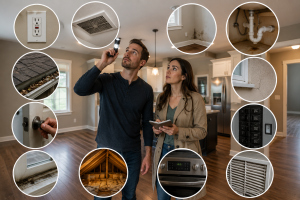
Most buyers walk through a home thinking about furniture placement. The costly surprises come from what they weren’t looking at.
That emotional momentum is natural. It’s also how buyers miss things that end up costing them serious money.
This isn’t about being cynical toward sellers or assuming every home has something wrong with it. Most don’t — or at least, most issues are manageable once you know about them. The problem is discovering them after closing instead of before. A thorough property walkthrough checklist in Texas mindset going into a showing can save you from expensive surprises, failed negotiations, and the kind of buyer’s remorse that sets in when the first major repair bill arrives.
Here’s what buyers consistently overlook — and how to approach walkthroughs with the discipline that good real estate due diligence actually requires.
The Foundation: Start at the Bottom, Always
Texas soil is notoriously expansive. Clay-heavy ground absorbs water and swells, then contracts when it dries out. Over years, that movement stresses foundations in ways that are expensive to fix and impossible to ignore once they’ve progressed.
Most buyers glance at the floors and move on. What they should be doing is looking at door frames. A door that sticks, doesn’t latch properly, or has a visibly uneven gap around the frame is telling you something about how the structure below it has moved. Same goes for windows — difficult operation, cracked glass with no apparent cause, or gaps in the frame are worth slowing down for.
Walk the exterior perimeter before you go inside. Look at where the foundation meets the ground. Small hairline cracks in concrete are often normal settling. Horizontal cracks, stair-step cracks in brick mortar, or gaps wider than a quarter inch are different categories of concern entirely. Home inspection red flags in Texas often start at the foundation and radiate outward from there.
“In Texas, the ground itself is part of the inspection. Buyers who skip the foundation conversation skip the most expensive conversation they might ever need to have.”
Water — The Silent Damage Maker
Water damage is the issue that’s easiest to hide and most expensive to remediate. Sellers don’t always disclose it honestly. Fresh paint, new carpet, or strategically placed furniture can conceal a lot. You need to look past the presentation.
Ceilings and Upper Wall Corners
Water stains on ceilings are obvious — but buyers often overlook upper wall corners, especially in rooms directly below bathrooms or exterior walls. Look for discoloration, bubbling paint, or a slightly different texture in the drywall. These are signs of moisture intrusion that may or may not be active, but either way they need to be explained.
Under Sinks and Around Toilets
Open every cabinet under every sink in the house. Look at the bottom of the cabinet — is it discolored, soft, or warped? Check the supply lines for corrosion at the connection points. Around toilets, press gently on the floor near the base. Any softness or give is a red flag for subfloor moisture damage from a slow leak that’s been there a while.
The Garage and Exterior Grading
Walk the exterior and pay attention to how the ground slopes near the house. The grade should direct water away from the foundation, not toward it. A yard that pitches toward the house, or downspouts that discharge directly against the foundation, are setup for chronic moisture problems in the crawlspace or slab. In Texas, improper grading is one of the most common contributers to foundation movement over time.
The Roof: Most Buyers Don’t Look Up
Serious buyers bring binoculars to walkthroughs. Or they at least stand in the yard and look at the roof from multiple angles. Most don’t look at all.
Roof replacement in Texas ranges from several thousand dollars for a modest home to well over $20,000 for larger properties. Hail damage — which is genuinely common in much of the state — can age a roof dramatically and may or may not have been reported to insurance. Look for missing or curling shingles, dark streaking (algae or moisture), sagging sections, or a roof that has clearly been patched in isolated areas.
Ask directly: when was the roof last replaced, and are there any insurance claims in the history? A seller who can produce documentation is a good sign. One who hedges or doesn’t know is worth pressing further.
While you’re looking up, check the gutters. Gutters full of granules from the shingle surface mean the roof is shedding material — a sign of age or hail impact that the shingles themselves might not make obvious from street level.
Electrical Panels and HVAC: Two Items Nobody Wants to Deal With
These are the two systems buyers most consistently avoid thinking about during a walkthrough — and the two that cause the biggest cost surprises after closing.
The Electrical Panel
Open the panel. Look at the brand. In Texas, older homes may still have Federal Pacific or Zinsco panels — both of which have documented safety concerns and are typically flagged by home inspectors as needing replacement. Beyond the brand, look at the overall condition: is it neat and organized, or is there a tangle of wires, doubled-up breakers, or breakers that are clearly hand-labeled after the fact? These are signs of work done without permits or outside of code.
The HVAC System
In Texas, HVAC is not optional. The system runs hard from April through October, and a unit that’s aging or underserviced will fail when it’s needed most. Check the age on the equipment — the manufacture date is usually on a label on the unit itself. Systems older than fifteen years are likely approaching end of life. Ask for the service history. A well-maintained system has records. One that doesn’t is a question mark.
Also check the supply and return vents throughout the house. Inconsistent airflow, rooms that are noticeably warmer or cooler than the rest, or a system that runs continuously without reaching the set temperature are all operational issues worth noting as part of evaluating homes before buying in the Texas heat.
Neighborhood and Location Details Nobody Tells You to Check
The property itself is only part of the picture. Hidden home issues in Texas aren’t always inside the walls — sometimes they’re outside the property line entirely.
Visit at Different Times of Day
A neighborhood that feels peaceful on a Tuesday at 11 a.m. may be completely different at 5:30 p.m. on a Friday. Traffic patterns, noise from nearby commercial areas, activity in adjacent properties — none of this shows up in listing photos. If the property is a serious contender, visit it at least twice at different times before making an offer.
Check the Flood Zone Status
Texas floods. It’s not a maybe — it’s a when, in many areas. FEMA flood maps are publicly accessible and show whether a property falls in a designated flood zone. Flood insurance requirements, costs, and the general risk profile of the property should be part of your evaluation before you get emotionally attached. Flood zone properties aren’t necessarily deal-killers, but they require different financial planning and risk assessment.
HOA Rules and Restrictions
In Texas suburban developments, HOA covenants can be extensive and binding. Buyers sometimes discover after closing that they can’t park a boat, run a home-based business, add a fence, or use their property in ways they assumed were fine. Read the HOA documents — not summaries, the actual documents — before you close.
Commercial and Investment Properties Deserve the Same Rigor
Everything above applies to residential purchases. But buyers evaluating commercial or investment property often skip the walkthrough discipline entirely and rely too heavily on income projections and pro forma numbers. That’s a mistake.
Physical condition matters in commercial real estate too — deferred maintenance, aging building systems, ADA compliance gaps, and environmental history are all factors that residential-style walkthrough discipline would catch. Whether you’re looking at commercial property in Texas or a hospitality asset like this Columbia Lakes portfolio hotel in West Columbia, TX, the physical due diligence discipline should be every bit as thorough as the financial analysis.
The same principle applies to land. Buyers looking to purchase land in Texas — whether for development, agricultural use, or long-term hold — often underestimate how much site-specific due diligence matters. Access, utilities, drainage, soil conditions, and easements on a land parcel are the equivalent of the foundation and roof on a residential property. Skipping that investigation is how land buyers end up with property that can’t be developed or used the way they intended.
For buyers exploring agricultural land in Texas, the walkthrough extends to fences, water infrastructure, soil quality, and any existing structures on the property — all of which require careful evaluation before closing. And for those considering off-market land opportunities, where less public information may be available, physical site visits become even more critical.
The Right Mindset for Any Property Walkthrough
The buyers who get the most out of walkthroughs are the ones who approach them as investigators rather than shoppers. They’re not there to fall in love — that part takes care of itself if the property is right. They’re there to understand what they’re actually buying.
That means slowing down. Opening cabinets. Running faucets. Flushing toilets. Standing in the backyard long enough to notice the drainage pattern. Looking at the roofline from the street. Asking questions that might feel awkward.
None of this is about being difficult or adversarial. It’s about making one of the largest financial decisions of your life with eyes fully open. A good broker — and a professional inspection — are your partners in that process.
If you’re actively looking at residential properties in Texas and want guidance on what to look for beyond the standard checklist, Airstream Realty works with buyers across property types and can help you ask the right questions before you make an offer.
Frequently Asked Questions
What are the biggest red flags to look for during a home walkthrough in Texas?
Foundation issues — sticking doors, uneven floors, cracks in brick or concrete — are the highest-priority concern in Texas due to expansive clay soils. Water damage signs including stained ceilings, soft subfloors near bathrooms, and musty odors are also critical. Roof age and condition, electrical panel brand and organization, and HVAC system age round out the top items that experienced buyers and inspectors focus on.
Should I hire a home inspector even if the walkthrough looks clean?
Always. A clean-looking walkthrough is not a substitute for a professional inspection. Inspectors use tools — moisture meters, thermal cameras, pressure tests — that reveal problems invisible to the naked eye during a standard showing. In Texas, where foundation issues, HVAC stress, and weather-related damage are common, skipping the inspection is one of the highest-risk decisions a buyer can make.
How do I check if a Texas property is in a flood zone?
FEMA’s Flood Map Service Center at msc.fema.gov allows you to search any property address and see its flood zone designation. Your real estate agent, lender, and title company can also pull flood zone information as part of the transaction process. Properties in high-risk flood zones (Zone A or Zone AE) typically require flood insurance, which adds to carrying costs and should be factored into your offer and budget.
What should I look for when evaluating an older home in Texas?
Homes built before the mid-1980s in Texas may have issues with original electrical panels (particularly Federal Pacific or Zinsco brands), galvanized plumbing that’s approaching end of life, older HVAC systems, and potentially asbestos or lead paint in materials. Foundation movement is also more likely in older homes where decades of seasonal soil expansion and contraction have had more time to accumulate. A thorough inspection by an experienced Texas inspector is especially important for older properties.
How many times should I visit a property before making an offer?
At minimum, twice — at different times of day. The first visit lets you get a general sense of the property. The second, ideally at a different time (evening versus morning, weekday versus weekend), lets you assess noise levels, traffic, neighborhood activity, and light quality in a way the first visit doesn’t capture. For properties you’re serious about, a third visit specifically focused on physical evaluation — foundation, roof, systems — is well worth the time.
What questions should I always ask the seller or listing agent during a walkthrough?
Ask when major systems were last replaced or serviced — roof, HVAC, water heater. Ask if there have been any insurance claims on the property in the last five years and what they were for. Ask about any known foundation repairs or water intrusion history. Ask about HOA rules and any pending special assessments. And ask whether any recent work was done with permits — unpermitted work can create complications at resale and may not meet current code.