
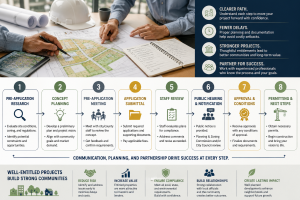
New developers often underestimate the entitlement process — not because it’s impossibly complex, but because nobody explained it to them clearly before they bought the land. This post does that. Start to finish, in plain terms, with the Texas-specific details that matter.
What “Entitlement” Actually Means
Entitlement is the umbrella term for the collection of approvals a development project needs before construction can begin. These approvals translate the legal concept of what you can theoretically do with land into the specific, permitted-and-documented authorization to do a particular thing on a particular piece of land.
The specific approvals involved depend on the type of project and the jurisdiction. A residential subdivision requires different entitlements than a commercial development; a project inside a city’s limits requires a different process than one in unincorporated county land. But the general framework is consistent: you start with a piece of land with certain baseline characteristics, and through the entitlement process you document, approve, and record what’s going to be developed there and how.
The most important thing to understand about entitlement is that it takes time — often more time than new developers expect — and that the clock doesn’t start until you’ve done the work to get the project into the review pipeline. Land that is already entitled (approvals in place, plat recorded) is worth more than comparable unentitled land specifically because someone already invested the time and cost to get through this process.
“Every entitled lot represents months or years of someone’s time and thousands of dollars of soft costs that got that piece of land to a state where someone could actually build on it. The price premium is not arbitrary.”
Entitled vs. Unentitled Land: The Value Difference
The distinction between entitled and unentitled land in Texas is one of the most consequential variables in any development acquisition. Understanding it specifically helps buyers evaluate land at different stages and understand why comparable acreage in similar locations can trade at dramatically different prices.
Unentitled land has not received development approvals — it may be zoned for development or have strong development potential, but the regulatory permission to build a specific product doesn’t exist yet. Buying unentitled land means you’re buying that potential plus the obligation to navigate the entitlement process yourself. The timeline and cost of that process are your risk.
Partially entitled land has completed some stages — perhaps a rezoning has been approved but the plat hasn’t been filed, or a preliminary plat has been approved but final engineering and infrastructure approval hasn’t been obtained. Each completed stage reduces risk and adds value.
Fully entitled land has completed the process — the plat is recorded, the infrastructure improvements are planned or in place, and building permits can be pulled with minimal additional regulatory delay. This land trades at a significant premium because the developer is buying a de-risked position rather than a raw opportunity.
The Entitlement Process: Stage by Stage
The land development process in Texas for most residential and commercial projects follows a recognizable sequence, though the specific steps and their order vary by jurisdiction.
Stage One: Pre-Application Due Diligence
Before submitting anything to any government body, competent developers do the due diligence that shapes the application. This includes reviewing the property’s current zoning, the jurisdiction’s comprehensive plan (which indicates intended future use), any deed restrictions or easements that affect development, utility service availability and capacity, flood plain status and FEMA flood map designation, and any environmental considerations (wetlands, protected species habitat, contamination history).
This pre-application work defines what the project can realistically be and whether the entitlement path is viable. Developers who skip it and start applications without understanding the constraints discover the constraints through the application process — which is a much more expensive and time-consuming way to learn.
Stage Two: Zoning and Land Use Approval
If the land’s current zoning doesn’t permit the intended use, a rezoning application is the first formal entitlement step. In Texas cities, this typically involves a formal application to the planning department, staff review against the comprehensive plan and applicable planning policies, a hearing before the Planning and Zoning Commission (P&Z), and a hearing before the City Council. The process typically takes 60 to 90 days for straightforward cases and 4 to 12 months for contested or complex cases.
Specific use permits (SUPs) or conditional use permits are alternative mechanisms for uses that are permitted in a zone with additional conditions. The variance process is for requests to deviate from specific development standards (setbacks, height limits) when the standard creates hardship. Each of these is a separate application with its own process.
Stage Three: Platting in Texas
Platting in Texas is the legal subdivision process that divides land into lots, blocks, and tracts that can be separately sold and developed. The Texas Local Government Code (Chapter 212 for municipalities, Chapter 232 for counties) governs the platting process and the standards that plats must meet.
Most Texas development projects require a plat — or an amending plat, replat, or minor plat depending on the project scope and what’s already recorded on the property. The platting process involves preparing a survey-grade plat document meeting the jurisdiction’s specific standards, submitting for staff review, revising based on comments, final approval by the governing body (for larger plats) or staff (for minor plats), and recording the approved plat in the county deed records.
Until the plat is recorded, individual lots within the development can’t be separately conveyed. The recorded plat is the legal document that creates the lots as distinct, transferable legal parcels. For a residential subdivision, this is a critical milestone — sales can’t close until lots exist as legal parcels, and lots don’t exist until the plat is recorded.
Stage Four: Infrastructure and Engineering Approvals
After the plat is approved (and sometimes concurrent with platting depending on the jurisdiction), the development’s infrastructure plans are reviewed and approved. Streets, drainage, water, sewer, utilities — all require engineered plans that meet the applicable standards, review by the relevant departments or utility providers, and approval before construction begins.
For larger projects in major Texas municipalities, this stage involves the Public Works department, utility districts (MUDs in Texas are a significant component of infrastructure financing), TxDOT for any state highway access points, and sometimes the Army Corps of Engineers for projects affecting waterways. The engineering review and approval timeline is 60 to 180 days for most projects, with more complex projects requiring longer.
Stage Five: Permits and the End of Entitlement
Entitlement is complete when building permits can be pulled. For most residential developments, this means the plat is recorded, infrastructure is approved (and in many cases constructed), and the project’s development agreements with the municipality are executed. The transition from entitlement to construction is the transition from regulatory process to physical development — the point where the investment in time and soft costs starts to produce something visible.
Pre-application due diligence: 30–90 days.
Rezoning (if required): 60–90 days simple, 4–12 months contested.
Platting: 60–120 days for preliminary plat; 30–60 days for final plat after preliminary approval.
Infrastructure/engineering review: 60–180 days.
Total from acquisition to entitled status: 6 months minimum for a straightforward project in a cooperative jurisdiction; 18 to 36 months is common for larger or more complex projects.
This timeline runs concurrently with due diligence, meaning some stages overlap — but the critical path typically runs 12 to 24 months for most Texas development projects.
For developers looking at Texas land at different stages of the entitlement process — from raw agricultural land with development potential to commercial property that may already carry entitlements — understanding where a parcel sits in this process is fundamental to evaluating the price and the risk. Residential land at various entitlement stages represents meaningfully different development positions, and the off-market land market often surfaces parcels at earlier entitlement stages where the opportunity is highest. The broader Texas land inventory spans the full entitlement spectrum. For a specific large Texas parcel where entitlement context is part of the opportunity, the 394-acre Tyler, TX property at Highway 20 and 155 is worth reviewing as an example of what a significant highway-fronting position looks like. And for the full practice and contact, Airstream Realty is the starting point.
Frequently Asked Questions
How long does the entitlement process take in Texas?
The timeline varies significantly by project complexity and jurisdiction. A straightforward residential subdivision in a cooperative suburban Texas municipality with a supportive comprehensive plan designation can be through the process in 6 to 12 months. More complex projects — those requiring rezoning, facing community opposition, involving significant infrastructure coordination, or situated in jurisdictions with longer review cycles — commonly take 18 to 36 months from acquisition to entitled status. Some projects in densely regulated jurisdictions or with significant environmental complexity take longer. Building the realistic entitlement timeline into acquisition underwriting, rather than assuming the best-case scenario, is one of the most important disciplines new developers need to develop.
What is platting in Texas and is it required for all developments?
Platting is the legal process of subdividing land into lots, blocks, and tracts that can be separately conveyed and developed, governed in Texas by Chapter 212 (municipal) and Chapter 232 (county) of the Texas Local Government Code. Platting is required when land is being divided into two or more parcels for the purpose of sale, development, or conveyance. Exemptions from platting requirements exist for certain agricultural uses and certain large-lot divisions, but most residential and commercial development in Texas requires a plat. Until a plat is approved and recorded in the county deed records, individual lots don’t legally exist as separate parcels and cannot be separately conveyed. The platted plat is the document that creates the legal lots the development is built on.
What does “soft costs” mean in the entitlement context?
Soft costs are the non-construction expenditures of a development project — the professional fees and process costs that don’t result in physical improvements. In the entitlement context, soft costs include survey and engineering fees, application fees paid to municipalities and state agencies, attorney fees for title review, land use counsel, and development agreements, environmental study costs, traffic impact analysis fees, market studies, and the internal costs of the development team’s time. Entitlement soft costs for a typical Texas residential subdivision can range from $50,000 to $500,000 or more depending on project scale and complexity, all spent before a shovel goes into the ground. These costs are part of the risk that entitled land prices reflect — buyers of entitled land are paying partly for the elimination of this process risk.
Can I sell land that is currently in the entitlement process?
Yes. Land in mid-entitlement is regularly sold in Texas, typically at a price that reflects the completed work and the remaining risk. Partially entitled land — where rezoning is approved but platting is not complete, or where the preliminary plat is approved but final engineering and infrastructure approval remains — trades at a premium over fully unentitled land because the completed work has reduced risk and advanced the development timeline. Buyers of partially entitled land are acquiring the work already done plus the obligation to complete the remaining process. The purchase contract for mid-entitlement land typically includes provisions addressing pending applications, assignment of approvals, and obligations for the seller to cooperate in the ongoing process after closing.
What is the difference between a preliminary plat and a final plat in Texas?
In Texas jurisdictions that use a two-stage platting process, the preliminary plat establishes the general layout of the subdivision — lot configuration, street alignment, utility easements, and the general development concept — and is the stage at which the jurisdiction’s substantive planning review happens. Conditions of approval from the preliminary plat stage are carried into final plat compliance. The final plat is the recording document — a survey-accurate legal document that meets the jurisdiction’s specific technical requirements and is recorded in the county deed records to create the legal lots. Not all Texas jurisdictions use both stages; some use only a single-stage plat review. The applicable process is jurisdiction-specific and should be confirmed with the relevant planning department before beginning the process.
What is a Municipal Utility District (MUD) and how does it affect entitlement in Texas?
A Municipal Utility District (MUD) is a political subdivision of the State of Texas authorized under Chapter 54 of the Texas Water Code to provide water, sewer, drainage, and sometimes other utility services to a defined area, financed through the issuance of tax-exempt bonds repaid through property tax assessments on the properties within the district. MUDs are common in suburban and exurban Texas development, particularly in Harris County and the broader Houston metro, because they allow infrastructure financing without municipal general obligation bonds or developer capital for infrastructure. Creating a MUD requires approval from the Texas Commission on Environmental Quality (TCEQ) and adds a layer of complexity to the entitlement process. For developers in areas where MUD creation is the anticipated infrastructure financing mechanism, engaging water district attorneys early in the entitlement process is essential.