
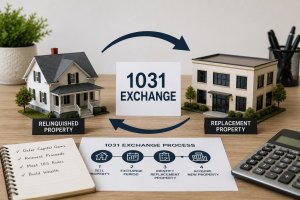
The 1031 exchange is one of the most powerful tools in the real estate investor’s toolkit — and one of the most often misunderstood. The concept is simple. The execution has specific rules that matter, and missing any of them can cost you the tax deferral you were counting on.
The Core Concept: Deferred, Not Eliminated
Understanding what a 1031 exchange does — and doesn’t do — is the right starting point. A like-kind exchange defers capital gains tax. It doesn’t eliminate it. The tax that would have been owed on the sale is rolled forward into the basis of the replacement property. When the replacement property is eventually sold without a subsequent 1031 exchange, the deferred gain (plus any additional appreciation) becomes taxable.
This distinction matters for planning. A 1031 exchange is a deferral strategy, and it’s most powerful when used repeatedly — exchanging into successively higher-value properties and deferring the gain indefinitely, or until a step-up in basis at death eliminates the deferred gain for heirs entirely. Used once, it buys time and preserves capital for reinvestment. Used as part of a longer-term investment strategy, it’s genuinely one of the most significant tax advantages available in real property investing.
“A 1031 exchange doesn’t make the tax go away — it reschedules it. The rescheduling can be indefinite if you keep exchanging, and at death the deferred gain disappears entirely under current law.”
What Qualifies: Like-Kind Property Rules
The term “like-kind” in the 1031 like-kind exchange context is broader than most people initially assume. Under current IRS interpretation, any real property held for investment or productive use in a trade or business qualifies as like-kind to any other real property held for investment or productive use — regardless of property type. Raw Texas land can exchange into a commercial building. An apartment building can exchange into agricultural land. A rental house can exchange into undeveloped acreage. The “kind” is real property held for investment; the specific type of real property is not the relevant classification.
Several categories of property do not qualify for 1031 exchange treatment. Your primary residence doesn’t qualify. Property held primarily for sale (inventory in a dealer’s hands — a developer who buys and immediately sells lots, for example) doesn’t qualify. Personal property (equipment, vehicles) was removed from 1031 eligibility by the Tax Cuts and Jobs Act of 2017, though real property remains fully eligible. Foreign real property exchanging into US real property (or vice versa) doesn’t qualify — the exchange must be US property for US property or foreign for foreign.
The Two Critical Timelines
The 1031 exchange rules that most frequently cause exchanges to fail are the timeline requirements. These are not flexible. They are statutory deadlines, and missing either one by a single day invalidates the exchange and triggers the full deferred capital gains tax.
The 45-Day Identification Period
From the date the relinquished property closes, the exchanger has 45 calendar days to identify the replacement property (or properties) in writing to the qualified intermediary. This is a hard deadline — no extensions, no exceptions for weekends or holidays. If day 45 falls on a Sunday, the identification deadline is that Sunday, not the following Monday.
The identification rules allow identifying up to three properties of any value (the three-property rule), or any number of properties whose combined fair market value doesn’t exceed 200% of the relinquished property’s value (the 200% rule). For most Texas land exchanges, the three-property rule provides sufficient flexibility. The identification doesn’t commit the exchanger to buying all identified properties — they just need to have identified compliant replacement candidates before the deadline.
The 180-Day Exchange Period
The exchanger has 180 calendar days from the close of the relinquished property to close on the replacement property (or properties). This runs concurrently with the 45-day identification period — meaning the identification window is contained within the 180-day exchange window, not sequential to it. Day 46 doesn’t start a new clock; day 46 is already day 46 of the 180-day period.
For exchanges that start late in the year, there’s an additional wrinkle: if the 180-day period extends past the tax return due date for the year the exchange began, the exchanger must request a tax filing extension to preserve the full 180 days. Failing to file for extension when the exchange is ongoing can compress the effective exchange period to the tax return due date rather than day 180. This is one of the specific complications that a qualified intermediary and a CPA familiar with 1031 exchanges both catch — and that a landowner navigating the exchange without professional guidance can miss.
The Qualified Intermediary: Why You Can’t Touch the Money
One of the most important mechanics of a valid 1031 exchange in Texas is that the exchanger cannot receive the sale proceeds at any point during the exchange. The funds from the relinquished property must go directly to a qualified intermediary (QI) — an independent third party who holds the funds in escrow — and flow directly from the QI to the purchase of the replacement property.
If the proceeds touch the exchanger’s hands, even momentarily, the exchange is invalidated and the full gain becomes immediately taxable. This is called “constructive receipt” and it ends the exchange. The QI structure is not bureaucratic overhead — it’s the essential mechanism that makes the exchange valid under the tax code.
Qualified intermediaries must be independent of the exchanger and the exchanger’s agents. Your attorney, your accountant, and your real estate broker cannot serve as your QI. The QI must be formally engaged before the relinquished property closes — engaging a QI after closing is too late. Setting up the QI relationship is the first practical step in any planned exchange, done well before the closing date on the property being sold.
Boot: When You Don’t Exchange Everything
The full tax deferral in a 1031 exchange requires exchanging all equity and replacing it with equal or greater value in the replacement property. When a exchanger takes some of the sale proceeds in cash, or acquires replacement property of lower value than the relinquished property, the non-exchanged portion is called “boot” and is immediately taxable.
Mortgage relief is also treated as boot. If the relinquished property had a $500,000 mortgage and the replacement property has only a $300,000 mortgage, the $200,000 net mortgage reduction is boot subject to tax, even if no actual cash was taken out. Understanding the boot calculation — and structuring the exchange to minimize it — is part of what a qualified intermediary and a CPA contribute to the transaction.
Day 0: Relinquished property closes. QI receives proceeds directly from closing — never to you.
Days 1–45: Identify replacement property in writing to QI. Three-property rule or 200% rule applies.
Days 1–180: Close on replacement property using QI funds. All equity must be deployed to avoid boot.
Before Day 0: Engage a qualified intermediary — the QI must be in place before closing, not after.
If exchange spans a tax return due date: file for extension to preserve the full 180-day window.
For Texas land owners whose 1031 exchange planning involves identifying replacement properties in the Texas land market — agricultural land, residential land, or commercial property — having a broker who knows the market is particularly important within the 45-day identification window. Off-market land opportunities can be a critical resource during the identification period when on-market inventory may not include the right fit. The broader Texas land inventory covers the full range of qualifying replacement property types. For a specific example of a larger Texas land holding that would suit exchange replacement needs, the 394-acre tract near Tyler, TX at Highway 20 and 155 illustrates the kind of exchange-suitable land parcel worth knowing about. And for the full practice and contact details, Airstream Realty is the right starting point.
Frequently Asked Questions
Can I exchange raw land for a commercial building in a 1031 exchange?
Yes. The like-kind requirement for real property 1031 exchanges under current IRS interpretation is broad — any real property held for investment or productive use in a business qualifies as like-kind to any other real property held for the same purpose. Raw land can exchange into commercial property, rental apartments, industrial buildings, agricultural land, or any other real property classification as long as both properties are held for investment or business use (not personal use) and both are US real property. The type of real property is not the “kind” — investment intent and real property status are the qualifying factors.
What happens if I miss the 45-day identification deadline?
Missing the 45-day identification deadline invalidates the exchange entirely. The proceeds held by the qualified intermediary are released to the exchanger, the full capital gain on the relinquished property becomes immediately taxable for the year of the sale, and there is no remedy or extension available. The 45-day deadline is statutory and absolute — the IRS does not grant extensions for missed identification deadlines regardless of circumstances. This is why the identification period should be approached with urgency from day one of the exchange, and why having a broker who can move quickly in the Texas land market during the identification window is a meaningful practical advantage.
Can I use a 1031 exchange for my primary residence?
No. A 1031 exchange requires the relinquished and replacement properties to be held for investment or productive use in a trade or business — not for personal use. A primary residence is specifically excluded from 1031 exchange eligibility. A former primary residence that has been converted to a rental property for a qualifying period before sale may be eligible for exchange treatment, but the IRS scrutinizes these conversions carefully and the conversion must be genuine rather than a brief technical conversion to access exchange treatment. Consult a CPA with 1031 exchange experience if you’re considering this scenario, as the facts and timing matter significantly.
How much does a qualified intermediary cost?
Qualified intermediary fees for a standard forward exchange typically range from $750 to $1,500 for a single-property exchange, though fees vary by QI provider and transaction complexity. More complex exchange structures (reverse exchanges, improvement exchanges, multiple properties) carry higher fees. The QI fee is a transaction cost of the exchange but is small relative to the capital gains tax deferral benefit on a significant real property sale — typically a fraction of one percent of the tax benefit produced. QI fees should be understood before engaging the QI; reputable QIs provide a clear fee schedule before the exchange agreement is signed.
What is “boot” in a 1031 exchange?
Boot is the term for the non-like-kind property received in a 1031 exchange — the portion of the transaction that doesn’t qualify for tax deferral and is immediately taxable. Boot can be cash (taking some of the sale proceeds rather than reinvesting all of them) or mortgage relief (the replacement property carries less debt than the relinquished property, with the net debt reduction treated as cash received). To achieve full tax deferral, the exchanger must acquire replacement property of equal or greater value than the relinquished property, replace all the equity, and replace all the debt (or add cash to compensate for reduced debt). Partial exchanges where some boot is accepted are common and produce partial tax deferral rather than full deferral.
Does a 1031 exchange eliminate capital gains tax permanently?
Not inherently, but it can under certain circumstances. A standard 1031 exchange defers capital gains tax — the gain is rolled into the basis of the replacement property and becomes taxable when the replacement property is eventually sold without a subsequent exchange. If the property is held until death, however, heirs receive a stepped-up basis to the fair market value at date of death under current law, which effectively eliminates the deferred gain permanently. The combination of repeated 1031 exchanges over a lifetime and a stepped-up basis at death is one of the most significant wealth transfer mechanisms available in real property investing. Changes to stepped-up basis rules have been discussed in Congress periodically but remain in effect under current law.