
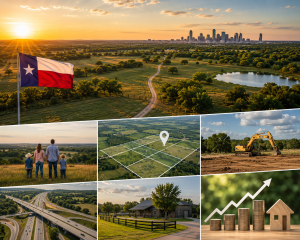
The case for North Texas land isn’t new. But what’s happening in 2026 makes the opportunity more specific and more urgent than the general bullishness about Texas has been for the past decade.
That version isn’t wrong. But it’s not precise enough to actually act on. Not all Texas land is the same. Not all parts of the state are in the same phase of their development cycle. And in 2026, the specific conditions in North Texas — the DFW metroplex and its expanding orbit — have created a window that looks meaningfully different from the general Texas narrative.
This post is about that window specifically. What’s driving it, where the opportunity is most concentrated, and what investors who understand North Texas land investment are actually doing about it.
What’s Different About North Texas in 2026
The DFW metro has been growing for decades. That’s not the story. What’s changed in the past few years — and what’s accelerating in 2026 — is the specific geography of where that growth is landing.
The urban core and inner suburbs absorbed the first waves of population growth. Then the established outer suburbs — Frisco, Allen, McKinney, Flower Mound — absorbed the next wave. By the early 2020s, these markets had matured to the point where land prices were reflecting growth that had already happened rather than growth that was still arriving.
The frontier has moved north, west, and south. The communities that are in the growth path now — Celina, Gunter, Anna, Melissa, Waxahachie, Midlothian, Cleburne — are in the early-to-middle stages of the same cycle that played out in Frisco fifteen years ago. This is the specific condition that makes buying land in North Texas different in 2026 than buying it in 2016 or 2022.
The difference between early-cycle and late-cycle land investment is not subtle. Early-cycle land is priced based on current use — typically agricultural or low-intensity rural. Late-cycle land is priced based on projected development value. The gap between these two valuations can be enormous, and the investors who capture it are the ones who got in before the narrative fully formed.
“The best land investments in North Texas history were made by people who bought what everyone else thought was farmland. In retrospect, it was Frisco.”
The Infrastructure Signals Worth Watching
Land values in a development corridor don’t appreciate randomly. They appreciate in response to specific triggers, and the most reliable of those triggers is infrastructure investment. When infrastructure arrives — roads, utilities, schools — land that was rural becomes developable, and developable land commands a dramatically different price than agricultural land.
In 2026, North Texas has several confirmed infrastructure developments that are already influencing land values in their surrounding areas:
Highway Expansions in the Outer Corridors
US-380 from McKinney westward through Celina and toward Decatur has been widened and improved in segments, and ongoing work is expanding connectivity across what was recently a two-lane rural highway. This single corridor is doing for the communities along it what US-121 did for Frisco and Allen in the late 1990s and early 2000s. Land within two to three miles of a highway expansion corridor consistently shows some of the strongest appreciation in any development cycle.
School District Expansions
School district footprints are among the most reliable leading indicators of residential development. When a North Texas school district announces new campuses, bonds for facility expansion, or boundary adjustments that incorporate previously rural land, that’s a concrete signal that residential development is projected and funded in those areas. Families follow schools. Housing follows families. Commercial development follows housing. Land values ratchet up through each stage.
Water and Utility Extensions
The single biggest constraint on development in the North Texas exurban zone has historically been water and utility availability. As municipal water systems extend their service areas outward and private utility cooperatives expand their capacity, land that was effectively undevelopable becomes entitleable. The extension of water service to a rural corridor often precedes significant land value appreciation by two to five years — which is the window that well-positioned investors are trying to identify and enter.
DFW Land Investment: Where the Opportunity Is Concentrated
DFW land investment in 2026 is not uniformly distributed. The most active appreciation is occurring in a specific ring around the metro — roughly the zone that starts at 30 to 40 miles from the Dallas core and extends outward to where rural character still dominates.
Collin County’s northern tier — Celina, Gunter, Sherman approaching from the south — has seen dramatic price movement in recent years and still has runway, particularly in the areas between confirmed development nodes where large parcels remain. Denton County’s western communities — Ponder, Krum, Decatur approaching from the east — are earlier in the cycle and have more price headroom remaining. Ellis County south of Dallas — Waxahachie, Midlothian, Ennis — represents the southern growth corridor that is receiving spillover from the established suburb markets around Cedar Hill and Mansfield.
For investors looking at Texas land for sale across these corridors, the current moment is meaningful. The communities that were genuinely early-cycle three years ago have moved. The communities that represent the next early-cycle opportunity are in the window now.
Agricultural Land and the Development Premium
Much of the North Texas land that is most interesting for investment purposes is currently classified and assessed as agricultural. This matters in two specific ways.
First, the agricultural tax exemption in Texas — which can reduce property tax liability by 80 to 95 percent on qualifying land — means that holding costs on agricultural parcels are dramatically lower than they would be on the same land without the exemption. An investor who can maintain the ag exemption through the holding period captures most of the land’s appreciation while paying minimal carrying costs. This changes the return math significantly compared to land without exemption status.
Second, when agricultural land transitions to residential or commercial use, the ag exemption rolls back — the prior five years of tax savings become due as a lump sum. This is a transaction cost that buyers and sellers need to account for explicitly in any deal involving exempted land. Understanding how the rollback works and who bears it in a given transaction is essential due diligence for anyone acquiring agricultural land in Texas with development upside in mind.
Off-Market Land: Where North Texas Deals Actually Happen
The listed market for North Texas land in 2026 is competitive. Properties that hit the MLS in growth corridors receive multiple inquiries quickly, and pricing increasingly reflects the market’s awareness of development potential rather than just current use value.
The off-market land opportunities in Texas are where the gap between listed pricing and underlying value still exists in meaningful form. Family landowners who haven’t recently tested the market, estate situations requiring discreet transactions, and agricultural operators considering transitions — these are the seller situations that produce off-market transactions at prices that aren’t available through the public listing process.
Accessing off-market opportunities requires relationships — with landowners, with local brokers who have those relationships, and with the specific geographic markets where opportunity is concentrated. This is not the type of investing that works through an app or a national listing aggregator. It works through persistent local presence and genuine market knowledge.
Commercial Land in the Growth Path
Residential growth creates commercial demand. The communities along North Texas’s growth corridors that are absorbing new residents need grocery stores, gas stations, medical facilities, restaurants, and service retail. The commercial land that sits at the intersections of these growing communities — particularly at highway junctions where traffic will route commercial users — is one of the more predictable investment theses in the North Texas market.
A specific example of the scale of commercial land opportunity that still exists in Texas highway corridors: this 350-acre tract at the Hwy 410 and 37 interchange in San Antonio illustrates the kind of large-scale commercial corridor positioning that captures value from multiple development vectors simultaneously. North Texas has analogous opportunities at its own major highway interchanges — the investors who identify and acquire these positions before the commercial development fully arrives are taking the same bet that has paid off at every prior stage of DFW’s expansion.
For investors interested in commercial property in Texas with a North Texas growth thesis, the current market is arguably more interesting than the residential land market — commercial land in early-cycle corridors has historically produced some of the strongest per-acre returns in DFW’s expansion history.
How to Position in the North Texas Land Market
For investors who are convinced by the thesis and want to act on it, the positioning question matters as much as the timing. A few principles that the most successful North Texas land investors tend to share:
Specificity beats generality. Buying “North Texas land” isn’t a thesis — buying a specific parcel in a specific corridor for specific reasons tied to confirmed infrastructure and demonstrable demand is. The returns in this market have gone to investors who had a clear view of why a specific piece of ground was in the path of growth, not to those who bought broadly based on the general Texas narrative.
Hold capacity matters. The North Texas land market rewards patience. The transition from agricultural to developed land takes years, sometimes a decade or more. Investors who need liquidity or who are sensitive to short-term value fluctuations are not well-suited to land holding strategies. Those who can hold through cycles without financial pressure are the ones who ultimately capture the return.
Residential land and development-path acreage in North Texas remain viable for investors with shorter time horizons than raw land, particularly in communities where housing demand is immediate and buildable lots are a more specific product than raw agricultural land.
For investors who want to discuss specific North Texas opportunities, market conditions, and transaction structures that match their specific investment profile, Airstream Realty works across the full Texas land and property spectrum with active presence in the North Texas market.
Frequently Asked Questions
Which specific areas of North Texas have the best land investment potential in 2026?
The most active appreciation is occurring in Collin County’s northern tier (Celina, Gunter, Van Alstyne, the Sherman approach from the south), Denton County’s western communities (Ponder, Krum, Decatur’s eastern approach), and Ellis County’s growth corridor south of Dallas (Waxahachie, Midlothian, Ennis). These areas are in different stages of the development cycle — Collin’s northern tier is further along, Ellis County and Denton’s western communities have more entry-point value remaining. The best individual opportunities within each corridor depend on specific parcel characteristics, infrastructure proximity, and market timing.
How do I evaluate whether a North Texas land parcel is actually in the development path?
Key evaluation signals include confirmed infrastructure investment within two to three miles (highway expansions, utility extensions, school bonds), actual building permit activity in adjacent areas (county permit databases are public), homebuilder option agreements and land acquisitions in the vicinity (also often traceable through deed records), school district boundary proposals that incorporate the area, and commercial development announcements that indicate market conviction from professional developers. A parcel with multiple of these signals is more compelling than one with a single indicator — convergence of signals is what distinguishes genuine development-path land from adjacent-to-development land.
What is a typical holding period for North Texas land investment?
Holding periods for development-path land in North Texas have historically ranged from three to twelve years depending on where in the development cycle the land was acquired. Early-cycle acquisitions — land bought before infrastructure arrives — tend to require longer holds (seven to twelve years) but produce the largest returns. Mid-cycle acquisitions (land bought after infrastructure is confirmed but before development has fully arrived) tend to produce returns over three to seven years. Late-cycle acquisitions typically have shorter paths to transaction but with proportionally lower appreciation potential. Investors need to match their capital time horizon to the cycle stage of their specific acquisition.
How does the Texas agricultural exemption affect land investment returns?
The agricultural exemption can reduce annual property tax liability by 80-95% on qualifying land, which dramatically lowers carrying costs through the holding period and significantly improves risk-adjusted returns. The downside is the rollback tax: when exempted land converts to non-agricultural use, five years of the tax savings become due as a lump sum. This rollback is a real cost that must be factored into acquisition underwriting and transaction structuring. In many North Texas deals, negotiating which party bears the rollback — buyer or seller — is a meaningful variable in deal economics. Investors acquiring ag-exempt land should understand and model the rollback before closing.
Is 2026 too late to get into the North Texas land market?
The honest answer is: it depends on where in North Texas and which cycle stage you’re entering. The Frisco and McKinney of this decade — the early-cycle communities that will be the next generation of established DFW suburbs — haven’t fully been priced in yet. Collin County’s northern tier has moved significantly but still has runway; Denton’s western communities and Ellis County’s growth corridor have more entry-point value remaining. The DFW metro continues to grow, infrastructure investment continues to push outward, and the structural demand drivers — corporate relocations, population inflows, housing formation — haven’t changed. Whether 2026 is “late” depends almost entirely on which specific parcel and corridor you’re evaluating.
What are the main risks of North Texas land investment?
The primary risks are: illiquidity (land is harder and slower to exit than more liquid assets, and the exit window often requires alignment with the development cycle); development path misidentification (buying land adjacent to growth rather than in the path of it); financing risk (land loans are more expensive and shorter-term than real estate loans, and changes in interest rate environment affect investor carrying costs); and regulatory risk (zoning, water district, and entitlement processes can be slower and less predictable than market analysis suggests). These risks are real and should be assessed against the potential return in every specific investment — they’re also why land in development paths still offers premiums over liquid assets despite its long track record of rewarding patient investors.