
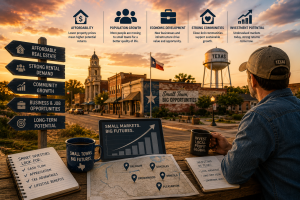
The big Texas metros have been the story for a decade. But the investors paying closest attention right now are looking at something else — and they’ve been right before.
But there’s a pattern that shows up repeatedly in real estate cycles: by the time a market is universally acknowledged as a great opportunity, the best entry points are mostly behind you. The investors who’ve done best in the DFW suburbs didn’t get there in 2022. They got there in 2014 or 2015, when the narrative hadn’t fully formed yet.
That pattern is playing out right now in small-town Texas real estate investing. Secondary markets — the towns that ring the major metros, the regional hubs that anchor their own rural areas, the communities that are starting to appear in migration data for the first time — are drawing serious capital for reasons that are structural, not speculative.
This post explains what’s driving that shift and where the real opportunity is for investors willing to look beyond the headline markets.
What’s Actually Driving Interest in Secondary Texas Markets
The interest in emerging Texas markets isn’t a trend driven by social media or FOMO investing. It’s driven by a set of structural factors that have been building for several years and are now reaching a point where they’re visible in transaction data.
Affordability Is a Real Problem in the Primary Markets
Austin median home prices crossed $500,000 and kept going. DFW suburbs that were affordable entry points five years ago now require prices that compress investor returns significantly. The institutional capital that flooded Texas real estate between 2020 and 2023 has fundamentally changed the return math in the most competitive markets.
Small towns don’t have that problem. A residential property that costs $350,000 in Frisco might cost $175,000 in Lindale or $150,000 in Palestine. The absolute dollar difference represents a return profile that investors working with limited capital — and even many with substantial capital — find significantly more attractive when they run the numbers side by side.
Remote Work Hasn’t Reversed
The remote work shift of 2020 hasn’t fully reversed, and the evidence suggests it won’t. The percentage of the American workforce that retains meaningful location flexibility has stabilized at a level that’s substantially higher than pre-pandemic baselines. That flexibility is what allows a family to choose Palestine over Plano, Nacogdoches over North Dallas, or Henderson over Highland Park — not because the small town has everything, but because they no longer need everything to be within 20 minutes.
This is new. The mechanisms that historically kept small Texas towns from attracting professional-class residents have been significantly weakened by permanent changes in how work operates. The consequence for real estate is a buyer pool for small-town properties that simply didn’t exist at the same scale five years ago.
Infrastructure Investment Is Following Population
When populations shift, infrastructure follows — with a lag. The communities that have been receiving new residents for two or three years are starting to see the commercial development, healthcare expansion, and service infrastructure that makes them genuinely viable for a broader range of people. This is the cycle that investors want to catch early: the new residents arrive first, commercial development follows, and property values adjust to reflect the improved infrastructure picture over the following three to five years.
“The best small-town Texas investments aren’t in towns that might grow. They’re in towns that are already growing — just before the market prices that growth in fully.”
North Texas Investment Opportunities Beyond the Suburban Core
North Texas investment opportunities have traditionally been concentrated in the DFW metro’s expanding suburban ring. But the outer edge of that ring has pushed out considerably, and the transitional zone between suburban and truly rural is where some of the most interesting current opportunities sit.
The I-30 and US-80 Corridors East of Dallas
The East Texas corridors — heading out of Dallas toward Tyler, Longview, and the Piney Woods region — have absorbed meaningful population spillover from the metro as buyers seek affordability without complete rural isolation. Tyler, the regional hub of East Texas, has been particularly active. But the towns between Tyler and Dallas — Mineola, Canton, Terrell, Kaufman — are showing the early-stage appreciation patterns that Tyler showed five to seven years ago.
A specific example of the kind of larger land opportunity that exists at these market intersections: this 394-acre tract at the northwest corner of Highway 20 and 155 near Tyler, TX represents the scale of land holding that becomes genuinely interesting at the intersection of a regional hub market and highway infrastructure. These are the positions that development-oriented capital has been acquiring in maturing suburban markets for years — and they’re still available at prices that reflect agricultural land rather than entitled development land in the Tyler corridor.
The Highway 380 Corridor in North Texas
US-380 running across the top of the DFW metro — through Denton, McKinney, Princeton, and out toward Decatur and beyond — has become one of the most active development corridors in the state. The towns along this corridor that were agricultural communities a decade ago are now subdivision targets. The communities just beyond the current development edge represent the same early positioning that McKinney represented in 2008 or Celina represented in 2016.
Rural Property Investment in Texas: The Land Side of the Story
Rural property investment in Texas deserves its own conversation, because it operates on different logic from residential investment in small towns.
Rural land in Texas has appreciated significantly over the last decade, driven by a combination of population growth pressure from the metros, increased interest in agricultural and recreational uses, and the general scarcity premium that comes with finite land supply in a growing state. But rural land appreciation in Texas is also highly uneven — land in the path of development appreciates dramatically; land without a credible development path appreciates more modestly and tracks primarily agricultural value.
The skill in rural property investment is distinguishing between these two cases before the market has done it for you. Key signals: confirmed infrastructure investment (roads, utilities, school district growth), specific commercial development announcements in adjacent areas, and the acquisition behavior of homebuilders and developers who typically identify and option land three to five years before they develop it. When you see builder options and land purchases increasing in a rural market, that’s a reliable leading indicator of impending appreciation that the public listing prices haven’t yet reflected.
For investors exploring agricultural land in Texas, the agricultural exemption status — and the careful management of that status through any transition toward development use — is a critical part of the investment calculus. The tax implications of ag exemption rollback can significantly affect the economics of a transaction for both buyer and seller, and understanding them in advance is essential.
The Secondary Housing Market Opportunity: What Investors Miss
Secondary housing markets in Texas have a specific characteristic that primary markets have lost: price sensitivity to improvements. In a market like Austin or DFW’s inner suburbs, the difference between a renovated property and an unrenovated one is compressed by overall market pricing — everything is expensive. In a small-town market, the spread between distressed and improved properties is often substantial, and the renovation investment has a clearer, more predictable return.
This is a fundamentally different investment proposition. The rental yield math is also different — small-town rents have risen with demand but starting from a lower absolute base, which means cap rates on residential properties in smaller Texas markets often look significantly better than comparable investments in the primary metros.
The risk profile is different too. Smaller markets have less liquidity — finding a buyer for a small-town property takes longer than finding one for a DFW suburb property. This illiquidity premium is one of the reasons the returns are there. Investors who don’t need quick liquidity and can hold through market cycles capture that premium. Those who need a fast exit don’t benefit.
Off-Market Land as the Highest-Value Entry Point
In small Texas markets specifically, off-market land opportunities represent some of the best risk-adjusted entry points available. The combination of limited local buyer competition, sellers who may not have tested the market recently, and properties that haven’t been exposed to competitive bidding creates conditions where patient buyers with market relationships can acquire at prices that reflect the land’s current use rather than its development potential.
This is how sophisticated land investors have operated in Texas for decades. The listed market is where you pay whatever the market currently believes the land is worth. The off-market is where you pay what the seller needs given their specific situation, which is often meaningfully less. The difference between these two numbers in transitional Texas markets is where real returns are created.
For commercial investors thinking about the commercial side of small-town Texas growth — the retail, industrial, and mixed-use development that follows residential population growth — commercial property in Texas in the secondary markets is a different and in some ways more interesting opportunity than in the saturated primary markets. Early commercial positioning in a growing small town creates a moat that’s very difficult for later entrants to replicate.
The full range of Texas land investment opportunities — residential, agricultural, commercial, off-market, and development-path land across the state’s major growth corridors — is what land listings at Airstream Realty covers. And for investors who want to discuss specific markets, property types, or strategies rather than just browse listings, Airstream Realty works across the full Texas land and property spectrum.
Frequently Asked Questions
What are the most promising small towns in Texas for real estate investment right now?
The towns generating the most investor interest in current market conditions include communities in the East Texas corridor between Dallas and Tyler (Mineola, Canton, Kaufman, Terrell), North Texas exurban communities beyond the established suburban ring (Princeton, Anna, Gunter, Whitesboro), Central Texas communities within 60-90 minutes of Austin (Bastrop, Lockhart, Luling, Gonzales), and select West Texas regional hubs where energy sector activity and cost-of-living advantages have drawn relocation buyers. The common thread is population growth that is real and documented, pricing that hasn’t yet fully reflected that growth, and some form of infrastructure investment confirming the direction of development.
What are the risks of investing in small Texas markets compared to major metros?
The primary risks are illiquidity (small markets have fewer buyers at any given time, making exit timing harder to control), economic concentration (a small town heavily dependent on a single employer or industry is more vulnerable than a diversified metro economy), and slower appreciation if the growth thesis doesn’t develop as anticipated. These risks are real and should be factored into every small-market investment evaluation. They’re also why the entry prices in small markets are lower — the illiquidity premium is built into the discount that makes small-market returns attractive. Investors with longer time horizons and less need for quick liquidity are better positioned to capture small-market returns than those who may need to exit quickly.
How do I evaluate whether a small Texas town is actually growing versus just stable?
The most reliable current indicators are building permit data (available from the city or county), school enrollment trends (growing enrollment reliably leads population growth), new business license filings (particularly food service and retail, which lag population by 6-18 months), and transaction volume in the local real estate market (increasing transaction count combined with declining days on market is a reliable growth signal). County appraisal district data showing increasing assessed values relative to historical norms is also informative. These are all publicly available data sources that don’t require paying for expensive market research to access.
What property types offer the best returns in small Texas markets?
Land in the development path of confirmed growth offers the highest potential return but with the highest variance and longest hold requirements. Single-family residential in appreciating small markets offers more predictable returns with better liquidity than land but lower ceiling appreciation. Commercial property at the correct stage of a market’s development cycle — when population is growing but commercial supply hasn’t caught up — offers strong current income plus appreciation potential. Agricultural land with development path characteristics combines favorable tax treatment during the hold period with significant appreciation potential as the market matures. The right answer depends on the investor’s capital position, time horizon, and risk tolerance.
Is the remote work trend a reliable long-term driver for small Texas market appreciation?
The available evidence suggests yes, within limits. Remote work flexibility has stabilized at a level meaningfully higher than pre-pandemic baselines and shows no signs of returning to historical patterns in knowledge-economy sectors. This flexibility is a structural change in who can live where — not a temporary phenomenon. The markets most likely to benefit long-term are those within a reasonable commuting or periodic-travel distance of major employment centers (roughly 60-90 minutes), with adequate broadband infrastructure, and with the lifestyle amenities that attract professional-class buyers. Small towns with poor internet infrastructure or very limited local services face a different demand curve than those who have addressed these basic requirements.
How do agricultural exemptions affect investment in small Texas markets?
Agricultural exemptions can reduce property tax liability by 80-95% for qualifying land, which dramatically improves the economics of holding rural land through a development cycle. However, conversion of ag-exempt land to non-agricultural use triggers a “rollback tax” that recovers five years of the tax savings — a liability that must be carefully accounted for in transaction planning. Investors buying ag-exempt land for development purposes need to understand who bears the rollback liability (typically the seller in standard contracts, but negotiable), the timeline for rollback assessment, and how to structure the transaction to avoid unintended tax consequences. Working with brokers and advisors experienced in Texas agricultural land transactions is essential for navigating this correctly.